英语基础知识
- 速查表(Cheat Sheet)
- 语法体系
- 核心语法(刘晓燕考研英语)
速查表(Cheat Sheet)
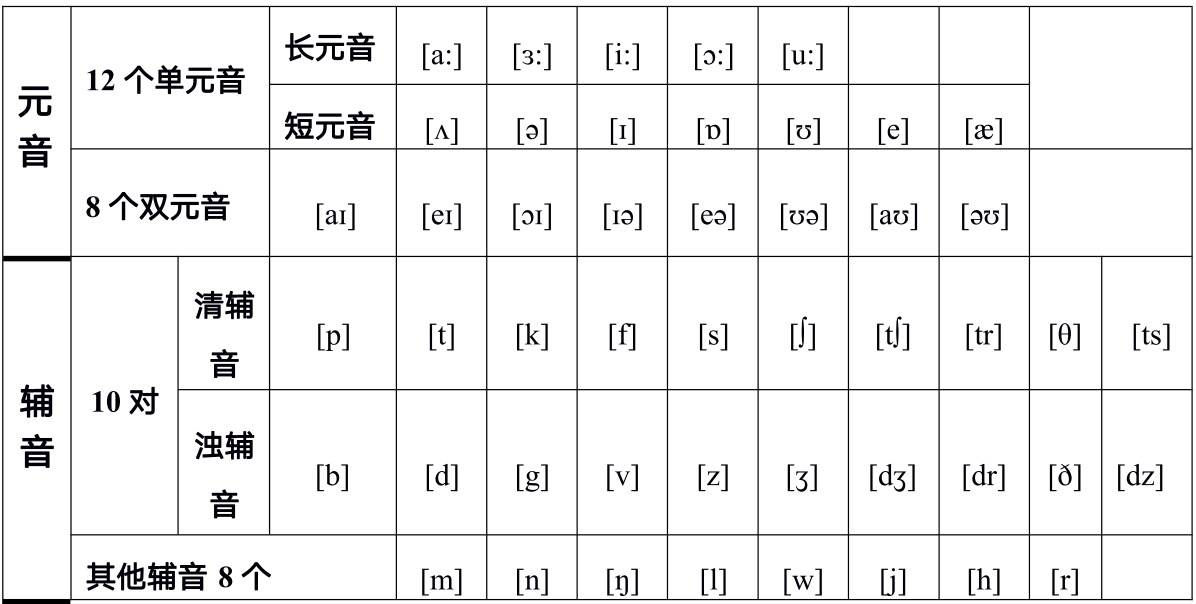
音标
用于不定冠词
要使用不定冠词 a 还是 an,取决于名词「第一个音素」,即名词的发音:
- 辅音发音开头用
a- 辅音音素是声音时发出的喉咙、口腔或唇部的阻塞,如
/b/、/k/、/t/、/g/等。 - a book
- a car
- a dog
- a house
- a pen
- 辅音音素是声音时发出的喉咙、口腔或唇部的阻塞,如
- 元音发音开头用
an- 元音音素是声音时发出的声带自由振动,如
/a/、/e/、/i/、/o/、/u/等。 - an apple
- an hour
- an elephant
- an honest person
- 元音音素是声音时发出的声带自由振动,如
用于单复数
元音字母:a, e, i, o, u
辅音字母:除了元音字母外的字母
词根词缀
后缀(suffix)
大多数情况下可以根据后缀直接判断词性
| 词缀 | 解释 | 例子 |
|---|---|---|
| -ion | 构成名词,表“状态,动作”等 | reaction transition cooperation |
| -ness | 构成抽象名词 | faintness n.微弱 |
| -ment | 构成抽象名词 | acknowledgement n.承认;感谢 |
| -ence | 构成抽象名词 | circumference n.圆周 dependence n.依靠 insistence n.坚持 |
| -ian | 构成名词,表示人 | statistician n.统计员 |
| -ance | 构成名词,表”性质,状态“ | appearance n.出现;外表 resemblance n.相似 disturbance n.扰乱 |
| -er | 构成名词,动词的执行者 | teenager n.青少年 tanker n. 油罐车 |
| -or | 构成名词,动词的执行者 | actor n.演员 tractor n.拖拉机 refrigerator n.冰箱 doctor n.医生 |
| -ess | 构成名词,表示女性,雌性 | headmistress n.女校长 goddess n.女神 actress n.女演员 |
| -ent | 构成名词 | compentent student president n.总统(preside 主持) |
| -ary | 构成名词;表”人,场所,物“ | Summary n.总结 library n.图书馆 salary secretary n.秘书 |
| -ism | 构成名词,表”主义(宗教),行为,特征“等 | mannerism n.言行举止 buddhism n.佛教 optimism n.乐观主义 |
| -ics | 构成名词,对…的研究,”学科,学术“ | pediatrics n.小儿科 economics n.经济学 mechanics n.机械学 physics n.物理学 |
| -logy | 构成名词,…学, …术 | psychology n.心理学 ecology n.生态学 geology n.地质学 biology n.生物学 sociology n.社会学 mythology n.神话学 |
| -ity | 构成名词,表性质 | Velocity n.速度 equality n.平等 familiarity n.熟悉 complexity n.复杂性 |
| -ing | 构成形容词或名词 | bowling n.保龄球 |
| -ive | 构成形容词或名词 | attractive adj.有吸引力的 affirmative adj. 肯定的 native n.本地人(nat 出生) detective n.侦探(detect 察觉) conservative adj.保守的;n.保守的人 |
| -ed | 构成形容词 | threaded adj.有螺纹的 |
| -y | 构成形容词,表“性质” | thready adj.线的 |
| -like | 构成形容词;像…似的 | Threadlike adj.线状的 |
| -less | 构成形容词;少,无 | collarless n.无领的 |
| -al | 构成形容词 | statistical |
| -ful | 构成形容词或名词,充满…的,有…性质的 | forgetful adj.易忘的 willful adj.任性的 handful n.一把的 spoonful n.一勺的 |
| -able | 构成形容词,能…的,易…的 | agreeable adj.可接受的;愉快的 |
| -ly | 构成副词 | Brotherly adv.兄弟般的 monthly adv.每月的 |
| -ate | 构成动词 | differentiate v.区别 |
前缀(prefix)
TODO
常见缩写(Abbreviation)
| Abbreviation | Original | Abbreviation | Original |
|---|---|---|---|
| aren’t | are not | can’t | cannot |
| hadn’t | had not | wasn’t | was not |
| shouldn’t | Should not | isn’t | is not |
| doesn’t | does not | don’t | do not |
| mustn’t | Must not | weren’t | Were not |
| wouldn’t | would not | didn’t | did not |
| I’m | I am | You’re | You are |
| He/She/It’s | He/She/It is | We’re | We are |
| You’re | You are | They’re | They are |
| shan’t | shall not | won’t | will not |
不规则动词
动词时态
| 状态/时间 | 过去的过去 | 过去 | 过去的将来 | 现在 | 将来 |
|---|---|---|---|---|---|
| 一般 | did 一般过去时 | would do 一般过去将来时 | do 一般现在时 | will do 一般将来时 | |
| 进行 | was/were doing 过去进行时 | would be doing 过去将来进行时 | am/is/are doing 现在进行时 | will be doing 将来进行时 | |
| 进行 | had been doing 过去完成进行时 | have been doing 现在完成进行时 | would have been doing 过去将来完成进行时 | will have been doing 将来完成进行时 | |
| 完成 | had done 过去完成时 | have/has done 现在完成时 | would have done 过去将来完成时 | will have done 将来完成时 |
非谓语动词形式
| 非谓语动词形式 | 一般式 | 进行式 | 完成式 | 一般式(被动) | 完成式(被动) |
|---|---|---|---|---|---|
| 不定式 | to do | to be doing | to have done | to be done | to have been done |
| 动名词 | doing | / | having done | being done | having been done |
| 现在分词 | doing | / | having done | being done | having been done |
| 过去分词 | done | / | / | / | / |
语法体系
总览
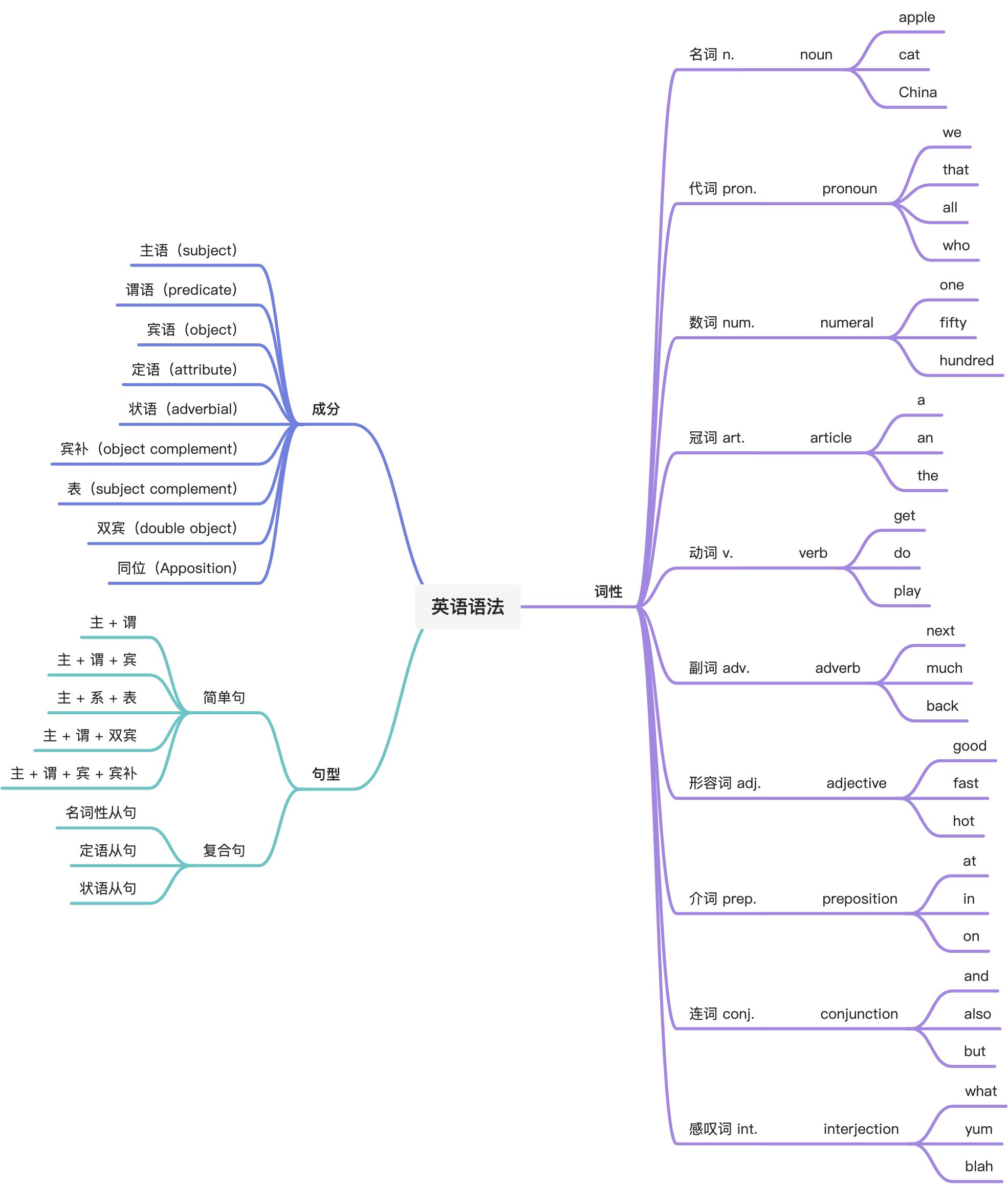
数词(num.)
基数词
个位数(0-9)
| 0 | 1 | 2 | 3 | 4 | 5 | 6 | 7 | 8 | 9 |
|---|---|---|---|---|---|---|---|---|---|
| zero | one | two | three | four | five | six | seven | eight | nine |
十到十九(10-19)
| 十 | 十一 | 十二 | 十三 | 十四 |
|---|---|---|---|---|
| ten | eleven | twelve | thirteen | fourteen |
| 十五 | 十六 | 十七 | 十八 | 十九 |
| fifteen | sixteen | seventeen | eighteen | nineteen |
十位数,二十到九十(20-90)
| 二十 | 三十 | 四十 | 五十 |
|---|---|---|---|
| twenty | thirty | forty | fifty |
| 六十 | 七十 | 八十 | 九十 |
| sixty | seventy | eighty | ninety |
二十以上,几十几(21-99)
例如: 二十一 => twenty one 九十九 => ninety nine 十位用几十,个位用个位
数字表达规律
- 从右往左,每三位一个逗号,倒数第一个逗号之前是thousand,倒数第二个逗号之前是million,倒数第三个逗号之前是billion,倒数第四个逗号之前是trillion
- 逗号之间的百位和十位都要加and,数字隔0要加and
一百到九百九十九(100-999): 一百(100)=> one hundred 一百零一(101)=> one hundred and one 九百九十九(999)=> nine hundred and ninety-nine
一千到九千九千九百九十九(1000-9999): 一千(1,000) => one thousand 一千零一(1,001) => one thousand and one 一千零二十(1,020) => one thousand and twenty 九千九百九十九(9,999) => nine thousand nine hundred and ninety-nine
一万到一万零九百九十九(10000-10999): 一万(10,000)=> ten thousand 一万零一(10,001)=> ten thousand and one 一万零二十(10,020)=> ten thousand and twenty 一万零两百(10200)=> ten thousand and two hundred 一万零九百九十九(10,999)=> ten thousand nine hundred and ninety-nine
一万一千到九万九千九百九十九(11,000-99,999): 一万一千(11*1000=11,000)=> eleven thousand 一万一千零一(11,001)=> eleven thousand and one 一万一千零二十(11020)=> eleven thousand and twenty 一万一千零二百(11200)=> eleven thousand two hundred 九万九千九百九十九(99999)=> ninety nine thousand nine hundred and ninety-nine
十万到九十九万九千九百九十九(100000-999999): 十万(100,000)=> one hundred thousand 十万零一(100,001)=> one hundred thousand and one 十万零二十(100,020)=> one hundred thousand 十万零二百(100,200)=> one hundred thousand and two hundred 十万零二千零一(102,001)=> one hundred thousang and two thousand and one 九十九万九千九百九十九(999,999)=> nine hundred and ninety-nine thousand nine hundred and ninety-nine
一百万到九千九百九十九万九千九百九十九(1,000,000-99,999,999): 一百万(1,000,000)=> one million 一百万零一(1,000,001)=> one million and one 一百万零一千(1,001,000)=> one million and one thousand 一百零一万(1,010,000)=> one million and ten thousand 九千九百九十九万九千九百九十九(99,999,999)Ninety-nine million nine hundred and ninety-nine thousand and ninety-nine
一亿到十亿以及更多(100,000,000-1,000,000,000-∞): 一亿(100,000,000)=> one hundred million 一亿零一(100,000,001)=> one hundred million and one 一亿零一千(100,001,000)=> one hundred million and one thousand 一亿零一百万(101,000,000)=>one hundred and one million 十亿(1,000,000,000)=> one billion 三百一十亿零二千九百万零八百八十八(31,020,900,888) => thirty-one billion and twenty million nine hundred thousand and eighty-eight
使用特点
- 作数词时候,前面可以加数词,后面不能加s,比如:two thousand(✅),three thousands(❌)
- 如果数词用作名词时候,意思是好几…的时候,前面可以加some/many/several这种词或者加数词,后面可以加of。例如:hundreds of(好几百),five hundreds of(五百左右),many millions of(数百万)
- 表示年龄 => I’m twenty(我20岁)
- 表示编号 => Room 101 = Room one 0 one
- 表示年代 => 1940’s = nineteen forty’s(20世纪40年代)
- 表示年份
- 2008 = two thousand and eight
- 1949 = nineteen forty-nine
- 2019.9.10 = Sep.10th, 2019 = September , tenth, twenty nineteen
序数词
第几(第零到第九)
| 第零 | 第一 | 第二 | 第三 | 第四 | 第五 | 第六 | 第七 | 第八 | 第九 |
|---|---|---|---|---|---|---|---|---|---|
| zeroth | first | second | third | fourth | fifth | sixth | seventh | eighth | ninth |
第十到第十九
| 第十 | 第十一 | 第十二 | 第十三 | 第十四 |
|---|---|---|---|---|
| tenth | eleventh | twelfth | thirtheeth | fourteenth |
| 第十五 | 第十六 | 第十七 | 第十八 | 第十九 |
| fifteenth | sixteenth | seventeenth | eighteenth | nineteenth |
第几十(第二十到第九十)
| 第二十 | 第三十 | 第四十 | 第五十 |
|---|---|---|---|
| twentieth | thirhieth | fortieth | fiftieth |
| 第六十 | 第七十 | 第八十 | 第九十 |
| sixieth | seventieth | eightieth | ninetieth |
把基数词结尾的y变成i再加eth
第二十以上,第几十几
十位用基数词,个位用序数词 第二十一 => twenty first 第九十九 => ninety ninth
第一百以上
第整数的后面加th,如果不是整数,保留基数词只变个位数
| 第一百 | 第一千 | 第一百万 | 第十亿 |
|---|---|---|---|
| one hundredth | one thousandth | one millionth | one billionth |
使用特点
- 使用序数词时,一般前面要加定冠词the
- I’m in the second room(我在第二个房间)
- 表示时间日期
- The first of September=Sep 1st(九月一日)
- 表示楼层
- The first floor(一楼)
- 表示几分之几,分子大于一,分母用序数形式
- one third = 1 / 3
- two thirds = 2 / 3
- 序数词前面加a/an表示再一,序数词前面加the表示顺序
- We read the book a third times(我们读了三遍这本书)
- The second door of the room is closed(房间的第二扇门是关的)
冠词(Articles)

1. 定冠词
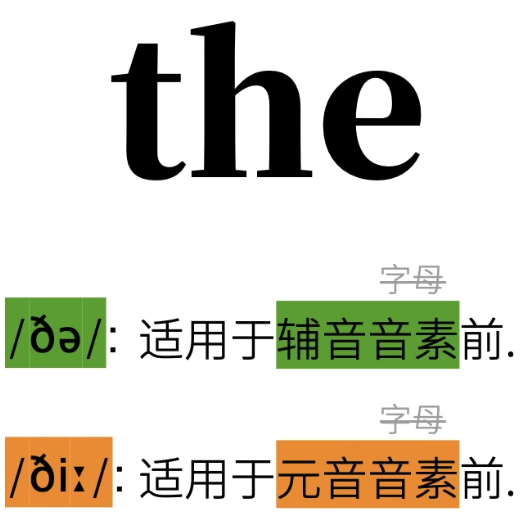 表示这个,特指某个名词,后面跟单数/复数名词,不可数名词
例如:
表示这个,特指某个名词,后面跟单数/复数名词,不可数名词
例如:
- 表示上文提过的人和物-This car is popular, but the car isn’t cheap
- 表示地理位置用-We are based in the Beijing
- 表示江河湖海用-The Yellow River
- 唯一存在的事物用-The earth
- 最高级前用-This is the best cup of coffee
- 表示强调时候用-Beijing is the capital of China
- 乐器(西洋古典乐器)之前用
- I like to play the piano
- 在形容词前用 the,会将形容词变成名词
- The rich should help the poor.
- 固定表达
- all the time 一直;总是
- by the way 顺便
- out of the question 不可能;没门
2. 不定冠词
泛指人和物,表示一个(不特定或泛指的),后面加单数可数名词辅音发音前面加a,元音发音前面加an
- 第一次提到的人和物-It’s a cat
- 如果是对唯一事物具体情况说明-Their dream is to go on a world tour(他们的梦想是去全世界巡回演出)
- 和名词连用作表语或者同位语,代表职业-I am an engineer
- 表示价格/速度/频率 - 80miles an hour
- 固定短语会用 - have a good time
3. 零冠词
有情况下可以不需要加任何冠词
- 很广泛的概念
- 复数泛指
- Computers have changed our way of life.
- Water is important.
- We breathe air.
- 书名/人名
- 某些城市/国家
- 某些山河湖海洲
- 星球
- 语言/球类/学科/棋牌
- I want to play football.
- 三餐/日期/季节(一般不加冠词,如果要特指可以加the)
- Summer is hot. Winter is cold.
- on Monday
- 固定表达
- from time to time 不时地
- face to face 面对面地
- out of question 毫无疑问
名词(Noun)
名词分类
专有名词、普通名词
专有名词(大多数不可数):人名、地名、国家、组织、单位、大型活动、著名事件(首字母大写,如果缩写全部字母大写) 普通名词:专有名词以外的名词
可数名词、不可数名词
| / | 可数名词 | 不可数名词 |
|---|---|---|
| 能否 【计数】 | ✅ | ❌ |
| 能否【加不定冠词(a/an)和数词(one、two)】 | ✅ | ❌ |
| 能否【加定冠词(the)】 | ✅ | ✅ |
可数名词(单数复数都可以,可以加数词计算):
- apple
- egg
- boy
不可数名词(只能单数,不可以加数词计算):
- water
- fire
- time
具体名词、抽象名词
具体名词(看得见摸得着、可数不可数都有):
- man
- Beijing
- book
- fire
抽象名词(无形的各种事物,大多数不可数):
- time
- hope
- love
单复数变化
规则变化
- 直接 + s:coats、jobs、hats
- 以 o,s,x,ch,sh 结尾,+ es:dresses, boxes, watches
- 辅音(除去A、E、I、O、U的 21 个字母) + y,变 y 为 i 加 es:cities
- 以 f 或 fe 结尾,变 f 为 v 加 es:half => halves; wife => wives
- 以 o 结尾
- 有生命 + es:patato => patatoes; tomato => tomatoes
- 无生命 + s:photo => photos; zoo => zoos
不规则变化
- man => men
- woman => women
- goose => geese
- foot => feet
- tooth => teeth
- child => children
- mouse => mice
- fish => fish
- sheep => sheep
- deer => deer
一直是复数的名词
- glasses 眼镜
- clothes 衣服
- scissors 剪刀
- tweezers 镊子
- congratulations 祝贺
- trousers 裤子
- amends 赔偿
- cahoots 同伙
- shenanigans 恶作剧
- smithereens 碎片
复合名词的变化
- man 或 woman 做前缀,前后都要复数:man actor => men actors
- 两个名词,后面变复数:boy friend => boy friends
- 可数名词 + 介词(短语),前面名词复数:sister in law => sisters in law
- 动词/过去分词 + 副词,加 s:stand by => stand bys
- 中间含有连字符,则在主体名词之后加复数词尾:stander-by => standers-by
名词所有格(Possessive)
名词所有格表示所有权或关系
’s 所有格(中英序一致)
单数名词、复数名词非 s 结尾,后加’s, 单数名词 s 结尾,也加’s,如:
- Jack’s 杰克的
- The boss’s car 老板的车
复数名词以 s 结尾,后加’, 如:
- Boys’
- students’
- girls’
用 and 连接并列名词时:
- 要表示各自的所有关系,则分别加’s
- Tom’s and Jack’s rooms. (汤姆的房间和杰克的房间)
- 共同关系,只在最后一个名词加’s
- Tom and Jack’s rooms. (汤姆和杰克的房间)
其他常见用法
- 日程时间
- 3 day’s holiday.(三天的假期)
- 国家城市
- Beijing’s policy
- 地方机构
- The airport’s service guide
- 各种单位
- 100 kilogram’s weight.
- 天体
- The Jupiter’s aura(木星的光环)
of 所有格(中英反序)
修饰前面的名词,表两个名词之问的所属关系
- The content of the book = The book’s content(这本书的内容)
‘s+of 双重所有格
- of + 名词’s
- This is a photo of my cat’s. (这是我的猫的照片)
- of + 名词性物主代词
- He is a friend of mine.
💚 名词主谓一致
主谓一致就是主语和谓语的单复数保持一致
- I (单) am (单) a student.
- They (复) are (复) students.
用单数的情况
主语表整体概念谓语一般都是用单数
【专有名词】谓语用单数
- The United States was founded in 1776.
- 美国建立于1776年
- “Three Kingdoms” is a good story.
- 三国演义是个好故事
【many a】 或 【more than one + 名词】做主语
- Many a man is smoking.
- 很多男人在抽烟
- More than one man is smoking.
- 不止一个男人在抽烟
【one and half + 复数名词】做主语
- One and half watermelons is in the fridge
- 冰箱里有一个半西瓜
时间、钱、距离、重量等【单位】看做整体
- Two doollars is no big deal.
- 两美元没什么大不了
- Four miles is not a long way.
- 四英里的路不远
- Three weeks is already enough for you to finish the work.
- 三周已经足够你完成这份工作了
加减乘除【运算】
- Five times five is twenty-five
- 5乘5是25
- One plus one is two
- 1加1是2
【each】, 【one】, 【no one】, some(any, no, every)+body(one, thing)作主语或限定词
- Each student is in the classroom
- 每个学生都在教室里
- Someone student is in the classroom
- 某个学生在教室里
【one of + 复数名词结构】
- One of the students in our school is from the United States
- 我们学校有一名来自美国的学生
the number of + 可数名词复数作主语
- the number of scientists in the lab is five.
- 实验室里有五名科学家
用复数的情况
【a number of】 + 【可数】名词复数作主语
- A number of scientists are a single.
- 许多科学家都是单身
【few】,【many】,【several】,【all】,【more】
- The few words are difficult.
- 这几句话好难
特殊情况
集体概念的名词:根据 Context 进行判断,【整体】概念谓语用【单数】,【个体】概念谓语用【复数】
- The family was in a poor way.
- 这个家庭生活贫困。(整体)
- The family goes to the movies together.
- 这家人一起去看电影。(个体)
【and】或【both…and…】连接两个单数名词作主语 -> 复数
-
He and his family are at the funeral.
-
Both China and the United States are big countries.
【and】连接两个单数词 -> 单数
- 指同一个人或事物或概念
- The Youtuber and traveler is his friend.
- 这个旅行家兼 Youtuber 是他的朋友
- 主语前有 【every】, 【each】, 【no】, 【many a】修饰
- Each day and night is busy.
- 每天从早忙到晚
【a/an + 单数名词 + or two】 -> 单数
- An apple or two is not enough.
- 一两个苹果是不够的
【one of two + 复数名词】-> 复数
- One of two apples are not enough.
- 一两个苹果是不够的
谓语动词与【of】后的名词【保持单复数一致】的情况
- some of
- plenty of
- a lot of
- lot of
- most of
- Most of the student was gone.
- Most of the students were gone.
- the rest of
- all of
- half of
- part of
- 分数、百分百 + of
就近原则
由距离谓语近的名词决定单复数
【There be】, 【Here be】:
- There is one computer and two phones.
- There are two computers and one phone.
- Here is one apple and two bananas.
- Here are two apples and one banana.
【or】 / 【either…or…】(二选一) / 【neither…nor…】(两者都不选,选另一个), 【not only…but…(also)】(不仅而且,两个都)连接并列做主语:
- His friends or he was dead.
- He or his friend were dead.
- Either my brothers or mother is going the garden.
就远原则
距离谓语远的名词,决定谓语的单复数
四除(but, except, besides, in addition to)
- DYE, but her roommates, is friendly.(DYE人很好,除了她室友)
- DYE, except her roommates, is friendly.(DYE人很好,除了她室友)
- DYE, besides her roommates, is friendly.(DYE人很好,除了她室友)
- DYE, in addition to roommates, is friendly.(DYE人很好,除了她室友)
五和(with, along with, together with, combined with, as well as)
- DYE, with her roommates, is friendly.(DYE和她室友人都很好)
- DYE, along with her roommates, is friendly.(DYE和她室友人都很好)
- DYE, together with her roommates, is friendly.(DYE和她室友人都很好)
- DYE, combined with her roommates, is friendly.(DYE和她室友人都很好)
- DYE, as well as her roommates, is friendly.(DYE和她室友人都很好)
包括(including)
- DYE, including her roommates, is friendly.(DYE、包括她室友人都很好)
而不是(rather than, instead of)
- DYE, rather than her roommates, is friendly.(DYE人很好,而不是她室友)
- DYE, instead of her roommates, is friendly.(DYE人很好,而不是她室友)
代词(pron.)
代词的种类繁多,最重要的是要掌握用法,不用太拘泥于他们的分类以及语法术语
代词就是用来代替名词的词。可以在句子中做主语、直接宾语、间接宾语、介词宾语
人称代词
指代人、地点、事物、想法,例如:
- I
- me
- she
- we
- us
- it
- you
- they
物主代词
表示名词的所有权关系,例如:
- My
- our
- your
- his
- her
- its
- their
反身代词
反身代词用于指代句子的主语,以“-self”(单数)或“-selves”(复数结尾),例如:
- myself
- yourself
- yourselves
- ourselves
- himself
- herself
- itself
- themself
指示代词
指代已经提到的名词,如:
- this
- that
- these
- those
- such
- none
- neither
不定代词
不定代词(Indefinite Pronouns)是一类代词,用来指代不特定数量或不特定对象的名词或代词。它们通常用于表示一般性或泛指的概念,而不指代特定的人、物或数量。不定代词可以在句子中充当名词的角色,用于代替或替代一个不确定的事物或概念。
many; much
many: 代替可数名词的复数
much:代替、修饰不可数名词
后接可数名词复数:a few(肯定意义)一些; few(否定意义)几乎没有
后接不可数名词:a little(肯定意义)一些; little(否定意义)几乎没有
例如:
- a few carrots 一些胡萝卜
- few carrots 很少(几个)胡萝卜
- a little water 一点水
- little water 很少水
some; any
some:一些(一般用在肯定句中)
any:一些(一般用在否定句、疑问句中)
例如:
- The rabbit needs some carrots.
- Does the rabbit need any carrots?
- The rabbit doesn’t need any carrots.
如果需要对方正面肯定的回答时也会用 some,例如:
- Would you like some coffee?
当 any 表示“任何一个”的时候,可以用在肯定句中,例如:
- The rabbit can eat any carrot.
- 兔子可以吃任何一个胡萝卜
each; every
each 和 every是“每”的意思,后接单数,例如:
- each carrot / every carrot
each 可以作代词,单独作主语,而每不可以单独作主语,需要后面 + 名词,例如:
- There are many carrots. Each (✅) is big.
- There are many carrots.Every(❌) is big.
each 表示 2 个或 2 个以上,every 表示 3 个或 3 个以上,例如
- There are many carrots on each side of the street.(✅)
- There are many carrots on every side of the street.(❌)
- 街道两旁有胡萝卜
either; neither
either、neither做主语时:
either: 两者中的每一个(谓语用单数)
neither: 两者中每一个都不(谓语用单数)
例如:
-
Give the rabbit this or that carrot. Either is good.
-
给兔子这个或那根胡萝卜,(两者中)哪一个都很好
-
Don’t give the rabbit this or that carrot. Neither is good.
-
不要给兔子这根或那根胡萝卜。(两者中)哪一个都不好
-
Either of the carrots is good.
-
(两个)胡萝卜哪一个都很好
both; all
both: 都;全部。both 是指两者都,例如:
- Both of the two rabbits are cute.
- 两只兔子都很可爱
all: 都;全部。all 是指“三者及以上都”,例如:
- All of the rabbits are cute.
- 全部兔子都很可爱
other; the other; another
other: 另外的;其他的(+名词),例如:
- I like this carrot. I don’t like other carrot.
the other: 特指两者中的一个,例如:
- This carrot is bigger than the other carrot.
another: 泛指 3 个或 3 个以上另一个,例如:
- The rabbit doesn’t like this carrot. Give him another carrot.
one; it
- The rabbit doesn’t like this carrot. Give him another one.
复合不定代词
| pron | 人 | 物 |
|---|---|---|
| every | everyone/everybody 每人;人人 | everything 每件事;一切事 |
| some | someone/somebody 某人 | something 某事 |
| any | anyone/anybody 任何人 | anything 任何事 |
| no | no one/nobody 没人 | nothing 没有事 |
形容词在修饰复合不定代词时要后缀,例如:
- The rabbit has something important to do.
- The rabbit has nothing important to do.
疑问代词
疑问代词(Interrogative Pronouns)是一类用于提问的代词,用来引导疑问句并询问关于名词的信息。疑问代词帮助我们获取特定信息,例如身份、数量、性质、地点等。
- who
- Who is that person?(那个人是谁?)
- Who are you going to the party with?(你和谁一起去派对?)
- what
- What is this?(这是什么?)
- What are you doing?(你在做什么?)
- which
- Which video did you like the best?(你最喜欢哪个视频?)
- whose
- Whose bag is this?(这是谁的包?)
连接代词
要理解连接代词必须先理解从句
连接代词引导主语从句,宾语从句和表语从句
连接代词有:
- who
- whom
- whose
- what
- which
- whoever
- whomever
- whatever
- whichever
“-ever”表示“任何,一切”的意思,起强调作用
例句:
-
I don’t know who you are.(who 引导宾语从句)
-
我不知道你是谁
-
What he said isn’t true.(what 引导主语从句,what 在此表示说话的内容)
-
他说的话不是真的
-
The important thing is which rabbit is smarter.(which 引导表语从句)
-
重要的是哪只兔子更聪明
-
The rabbit wants to eat whatever he likes.
-
兔子想吃他喜欢的任何东西。
关系代词(引导定语从句)
关系代词是一种用于引导定语从句(Relative Clauses)的词语,它们在从句中充当名词的作用,用来代替或指代先行词,从而使句子更加简洁和连贯。关系代词通常用于修饰或限定名词,并引导对先行词的进一步描述。
- who(谁,用于指代人)
- The rabbit who became hungry ate a carrot.(饿了的兔子吃了根胡萝卜)
- The girl who is singing is my sister.(正在唱歌的女孩是我妹妹。)
- The person who called you is my cousin.(打电话给你的人是我的表弟。)
- whom(谁,用于指代人,通常作为宾语)
- The rabbit whom I saw ate a carrot.(我看见的那只兔子吃了根胡萝卜)
- whose(谁的,表示所属关系,用于指代人或物)
- The rabbit whose ears are long ate a carrot.(那只耳朵长的兔子吃了根胡萝卜)
- The book whose cover is red belongs to me.(封面是红色的那本书是我的。)
- which(哪个,用于指代物)
- I bought the cake which is on the table.(我买了桌子上的蛋糕)
- The rabbit ate the carrot which / that I bought.(兔子吃了我买的胡萝卜)
- that(谁,哪个,用于指代人或物)
- The car that I bought is brand new.(我买的那辆车是全新的。)
- The book that I’m reading is very interesting.(我正在阅读的那本书非常有趣。)
- as
- The rabbit ate the carrot, as was expected.(兔子如预料的那样吃了胡萝卜)
介词(prep.)
介词用法
定语
- The method of success.
- 成功的方法
状语
- She lives in Vancouver.
- 她住在温哥华
表语
- It is in the right screw.
- 它是一个正确的螺丝
宾补
- He put the cellphone on the desk.
- 他把手机放在桌子上
同位语
- As a doctor, he is responisble for his patient.
- 他作为医生,他对他病人负责
介词分类
按结构分
- 单个介词
- at
- in
- of
- after
- 合成介词
- into
- inside
- outside
- 分词介词
- includeing
- considering
- 短语介词
- in front of
- by way of
- at the end of
- accord of
按词义分
- 地点
- 方向
- 时间
- 方式
- 涉及
- 目地
- 原因
- 比较
- 伴随
介词易混
地点on、in、at
- at 某个具体位置、加小地点
- At bus station
- At No.12 avenue
- in 后面跟大地点
- In Beijing.
- on 表示在上面,后面加楼层
- On the 1st floor.
时间 on、in、at
- at 后面跟具体时刻,一天中的具体时间点,具体的周和节日
- At midnight
- on 后面跟具体的时间,某年某月某日星期几
- On Monday September 2nd 2019.
- in 后面跟年、月、早晚、季节,一段时间,将来时中表示一段时间之后
- In Spring.
- We will meet in a few days.
方位 on、in、to
- in 是 a 在 b 里面
- Kunming lies in the southwest of China.
- on 是 a 和 b 连着
- Canada lies on the north of American.
- to 是 a 和 b 不连着
- Japan lies to the east of China.
- to 表示方向
- to the south.
- on 表示左右
- on the left.
时间 after、in
- after + 具体时刻或者从句:表示在什么时刻之后,跟一般时态
- I was always playing football after school.
- 我放学后总是踢足球
- in + 一段时间:表示在多久之后,跟将来时态
- We will study math in a new semester.
- 我们将在新学期学习数学
时间 since、for
- since + 具体时刻或者从句:自从什么时候起,一直到现在
- Since Ford died, that’s all changed.
- 自从福特死了,这一切都变了
- for + 一段时间:总共有多长之久
- The school history for two hundred years.
- 这学校历史长达 200 年
in the front of、in front of
- in front of 表示在某物范围外的前面
- There is a tree in front of the school.
- 学校前面有一棵树
- in the front of 表示在某物范围内的前面
- We sit in the front of the bus.
- 我们坐在公交车的前面
by、in、with
- by 乘坐交通工具、以什么方式
- I have to go by bus.
- 我不得不坐公交车去
- in 使用某种语言文字
- He has a speech in English today.
- 他今天发表了一篇英文演讲
- with 使用某种工具方法
- Blending with Light
- 光合作用
through、across、over
- through穿过、通过森林、人群、门等等
- It passes through the Alataw Pass inhto Kazakhstan.
- 它通过阿拉山口进入哈萨克斯坦
- across和 over 跨越、跨越过河流、街道、围墙
- I run across the street.
- 我跑过马路
- I climbed over the fence
- 我翻阅围墙
under、below、beneath
- under在…之下,表示某物接触或覆盖某物时
- We finished the project in under a year.
- below 某物低于某物、或者表示温度用
- Below freezing.
- 冰点以下
- beneath 在…之下(抽象概念),能力、地位、期望低
- The game is beneath my expectations.
- 这游戏低于我的预期
in、into
- in 在…里面
- I walk in the school.
- 我在学校里走
- into 朝着…里面去
- I walked into the school.
- 我走进了学校
介词搭配
- 介词+名词
- for your car
- 介词 + 代词
- with her
- 介词 + 动名词
- for coming here
- 介词 + 形容词
- from young to old
- 介词 + 副词
- since then
- 介词 + 动词
- of winning
- 介词 + 不定式
- to make him angry
- 介词 + 从句
- at which I fell asleep was very boring.
- 介词 + 数词
- over 100 people
- 介词 + 介词
- just before us
动词(v.)
动词分类
能做谓语
实意动词
vi.、vt.
- 及物动词(vt.),后面加宾语
- I hate you.
- 不及物动词(vi.),后面不加宾语
- I fly.
- 及物+不及物动词(根据情况加宾语)
- I stop.(我停下)
- I stop working.(我停下工作)
- 不及物动词没有被动句,因为它后面不能加宾语
系动词
引导表语或表语从句
- be 动词
- am
- is
- are
- 感官动词
- feel
- look
- smell
- sound
- seem
- 变化动词
- get
- bacome
- turn
- grow
- 保持动词
- keep
- stay
- remain
- rest
静态动词
表示拥有、情感、思想的动词
- 拥有
- have
- own
- want
- contain
- 情感
- love
- hate
- want
- need
- 思想
- know
- think
- understand
- believe
动词短语
TODO
不能做谓语
助动词
协助主要动词构成谓语的词,没有实际意思,不能单独使用,构成时态、语态、否定句、强调句、疑问句
- have 做助动词,构成完成时:
- I have turned off the light.
- 我已经把灯关了
- do 做助动词,构成疑问句、否定句、强调句
- Do you have kids?
- 你有孩子吗?
- I do not know.
- 我不知道
- Do come with you.
- 一定要跟你去
- be 动词做助动词,构成进行时或被动语态
- I am watching this video.
- 我正在看这个视频
情态动词
情态动词有含义,和动词原型一起构成谓语
- can/could 表示推测、允许、能力
- You can imagine the story is bad.
- 你可以想象这个故事不好
- You could have been hurt.
- 你可能会受伤
- may/might 表示推测、允许、请求、祝愿
- It may rain today.
- 今天可能下雨
- I might be the next lucky dog.
- 我可能是下一个幸运儿
- must 表示肯定推测、命令
- It must be her.
- 这一定是她
- You must choose.
- 你必须选择
- should/shall/ought to 表示推测、需要、征求意见
- You should be careful.
- 你要当心
- Shall we regain the shore alive?
- 我们能活着回到岸上吗?
- Would/will 表示将要、请求、意愿
- Would you like to come with me?
- 你要跟我一起来吗?
- be able to 能够
- have to 必须
- had better 最好
动词形式
动词形式决定时态
原形
- 与助动词与情态动词一起构成谓语,要用原形
- Do you like English?
- 你喜欢英语吗?
- 祈使句的谓语动词,要用原形
- Don‘t move.
- 别动
- 感官动词的宾语与宾补构成逻辑上的主谓关系,表示动作的最后结果或全过程时,作宾补的动词要用原形
- I heard a coin drop.
- 我听到一个硬币掉了下
- 使役动词后的宾语与作宾补的动词构成逻辑上的主谓关系时,动词要用原形
- He let Jack lead the way.
- 他让杰克在前面带路
- 两个以上的并列不定式用 and 或 or 连接起来,动词要用原形
- Let’s go and play football.
- 我们去踢球
- 在 why not…和 why…句型中,not 和 why 直接跟动词原形,构成反问,表示“建议、劝告、责备或提醒”等。
- Why not use my bicycle?
- 为什么不用我的自行车呢?
- 动词 help 后是宾+宾补,其宾补由动词充当时,动词用原形
- I was helped to clean the room by her.
- 她帮我打扫房间
- do, does, did 与动词原形连用
- Do be careful!
- 一定要当心!
- 不定式作介词 but 和 except 的宾语,前面有实意动词 do 时,后面的动词不定式要省略 to
- Jack had nothing to do but/except watch TV.
- 杰克除了看电视外无事可做
- 固定的句型中,用原形
- had better(最好)
- You had better have a good rest.
- 你最好好好休息一下
- would rather(宁愿)
- I would rather study at home
- 我宁愿在家学习
- would rather … that … (宁愿…而不)
- had better(最好)
第三人称单数
一般现在时,主语是第三人称单数时,谓语要用第三人称单数 第三人称单数:
- 人称代词:he she it
- 单个人名
- 地名
- 单数可数名词
- 不可数名词
例句:
- It looks like a cat
- Beijing is in China
- The cat is Lucy’s.
- The water is very cold.
动词变第三人称单数:
- 直接在动词结尾加 s
- 以 s、x、ch、sh、o 结尾加 es
- 辅音字母加 y 结尾,y 变成 i 加 es
- 不规则变化
- have => has
- be => is
动名词和现在分词
- 动名词起着名词的功能,常在句子中充当主语、定语、表语等成分
- 现在分词来构成进行时态,与助动词 be 搭配构成句子的谓语,现在分词在句子中还可以充当定语、表语和状语
- 词尾加 ing
- play -> playing
- working
- 词尾是 e 去掉 e 加 ing
- ride -> riding
- 词尾是 ie 把 ie 变成 y 加 ing
- tie -> tying
- 辅音加元音加辅音双写辅音加 ing
- beg -> begging
过去式和过去分词
过去式单独做谓语,表示过去某个时间发生动作
- 加 ed
- play -> played
- e 结尾加 d
- love -> loved
过去分词是动词的非谓语形式,表示被动或完成
| 动词 | 过去式 | 过去分词 |
|---|---|---|
| arise | arose | arisen |
| be | was/were | been |
| babysit | babysat | babysat |
| beat | beat | beaten |
| become | bacame | become |
| bend | bent | bent |
动词时态
动词时态 = 动作的时间 + 动作的状态
使役动词
表示一个人或事物导致或引起另一个人或事物执行某个动作。使役动词有助于表达一个主体如何影响其他事物或人,或者导致某个动作的发生。使役动词通常分为两种类型:直接使役和间接使役。
- 直接使役动词(Direct Causative Verbs):表示一个主体直接迫使另一个人或事物执行某个动作。
例子:
- Make(使,迫使):She made him study.(她迫使他学习。)
- Force(强迫):They forced the door open.(他们强行打开了门。)
- Compel(迫使):The teacher compelled the students to complete the assignment.(老师迫使学生完成作业。)
- 间接使役动词(Indirect Causative Verbs):表示一个主体以某种方式引起或影响另一个人或事物,使其执行某个动作。通常需要使用辅助动词 “have” 或 “get”。
例子:
- Have(让,使):I had my car repaired.(我让我的车修好了。)
- Get(让,使):She got her hair cut.(她让头发剪了。)
- Allow(允许,使):The teacher allowed the students to leave early.(老师允许学生提前离开。)
副词(adv.)
副词的主要目的就是更精确地描述,补充,修饰各类词性
副词的用法
副词修饰哪些词性
- 修饰动词
- This rabbit runs fast
- 修饰形容词和副词
- This is a very fast rabbit
- This rabbit runs very fast.
- 修饰名词
- This rabiit here runs very fast.
- 修饰句子
- Obviously, this rabibit here runs very fast.
副词在句子中作什么成分
- 状语,定语
- 表语(主语补语)
- The worf is broad.
- 宾语补语
- Let me in!
副词的形式
- 同拼写,同义、近义
- fast(快)
- 同拼写,异义
- pretty(漂亮,相当)
- 副词 = 形容词 + ly,同义、近义
- quick, quickly(快)
- 副词 = 形容词 + ly,异义
- large (大)
- largely (基本上)
副词的种类
方式副词
方式副词可以位于句首,句中,句尾,但不是所有方式副词都可以
- Suddenly, the driver turned left.
- The driver suddenly turned left.
- The driver turned left suddenly.
程度副词
程度副词一般位于它修饰的形容词或副词之前。
- This is a very fast rabbit.
- This cat runs very fast.
地点副词
地点副词一般出现在句尾;表强调时也可以位于句首
-
The rabbit eats carrots indoors / outdoors.
-
这兔子在室内、室外吃胡萝卜
-
The rabbit eats carrots upstairs / downstairs.
-
这兔子在楼上、楼下吃胡萝卜
-
Here you can relax and forget about all your troubles.
-
在这里你可以放松并忘记所有烦恼
时间副词
- 一般位于句尾:
- The rabbit ate some carrots yesterday.
- The rabbit is eating some carrots now.
- The rabbit will eat some carrots later.
- 也可放句首、或居中:
- The rabbit has already eaten some carrots.
- 兔子已经吃了些胡萝卜
频率副词
大多数位于行为动词之前,be 动词、助动词、情态动词 之后
- The rabbit eats carrots every day.
- Sometimes, the …
- The rabbit usually …
- The rabbit eats carrots three times a day.
- I will always love you.
疑问副词
疑问副词是用来构成特殊疑问句的副词
- 对方式提问
- How does the rabbit eat carrots?
- 对地点提问
- Where does the rabbit eat carrots?
- 对时间提问
- When does the rabbits eat carrots?
- 对原因提问
- Why does the rabbit eat carrots?
连接副词
引导名词性从句的副词
- How the rabbit eats carrots is interesting.(How主语从句)
- I don’t know where the rabbit eats carrots.(where引导宾语从句)
- That is why the rabbit eats carrots.(why引导表语从句)
关系副词(引导定语从句)
引导形容词性从句(定语从句)
- where(哪里,表地点)
- This was the place where the rabbit ate the carrot.(这就是兔子吃胡萝卜的地方。)
- This is the place where we first met.(这是我们第一次见面的地方。)
- The house where I grew up is now for sale.(我长大的那座房子现在出售。)
- why(为什么,表示原因)
- This is the reason why the rabbit ate the carrot.
- I don’t know why he left.(我不知道他为什么离开。)
- when(当,表示时间)
- That was the day when the rabbit ate the carrot for the first time.
- This is the day when I met her.(这是我遇到她的那一天。)
- This is the time when we usually have lunch.(这是我们通常吃午饭的时间。)
- how(如何,表示方式或方法)
- She showed me how to solve the problem.(她告诉我如何解决这个问题。)
- She explained how to use the new software.(她解释了如何使用新软件。)
句子副词
一般在句子的开头,用逗号和主句分开
- Obviously, this rabbit here runs very fast.
形容词(adj.)
形容词的用法
定语
前置定语
- a hungry rabbit
- a little white rabbit
顺序:限定词 + (主观)特征 + 尺寸 + 形状 + 新旧 + 颜色 + 来源 + 材料 + 用途 例如:a beautiful big round new black Chinese wooden table 中文:一张崭新的漂亮的黑色中式木质大圆桌
后置定语
比如,形容词修饰符合不定代词
- somebody
- somebody nice
- 某个好人
- anybody
- anybody absent
- 不在场的人
- everything
- everything possible
- 所有可能的事儿
- nothing
- nothing wrong
- 没不对的事儿
形容词短语作定语
一般,形容词短语会放在描述的对象之后,比如:
- carrots good for the rabbit
- 对兔子有好处的胡萝卜
- the rabbit eager to eat carrots => the rabbit tat is eager to eat carrots
- 急于吃胡萝卜的兔子
- the rabbit busy eating carrots => the rabbit that is busy eating carrots
- 忙着吃胡萝卜的兔子
表语
- The rabbit is alive / asleep / alone.
- 兔子是活的/睡着的/孤单的
- the only rabbit alive
- 唯一一只活着的兔子
补语
- Carrots make rabbits happy.
- 胡萝卜让兔子开心。
- 形容词 happy 补充说明了宾语 rabbit的状态,作宾语补语
状语
- The rabbit came home, tired and hungry.
- 兔子回到家,又累又饿
- tired and hungry 表示兔子回到家时的状态,作状语
形容词的构成
简单形容词
例如:
- hungry
- little
- white
复合形容词
现在分词和过去分词也可以做形容词 形容词 + 形容词/现在分词/过去分词:
- a red-hot coal
- a good-looking rabbit
- a new-born baby
副词可以放在形容词前修饰形容词,副词 + 形容词/现在分词/过去分词:
- all-round
- hard-working
- recently-built
形容词/数词 + 名词(需要+ed,与过去式无关):
-
white-haired = … whose hair is white
-
白发的
-
kind-hearted = … whose heart is kind
-
好心的
-
a long-distance call
-
a one-way street
名词 + 形容词/现在分词/过去分词:
-
a snow-white rabbit = a rabbit that is white like snow
-
一只雪白的兔子
-
a carrot-eating rabbit = a rabbit that eats carrots.
-
一只吃胡萝卜的兔子
-
a heart-broken rabbit = a rabbit that heart is broken.
-
一只心碎的兔子
比较级&最高级
构成
音节少的词,一般构成是形容词+er, est,有些需修改拼写以防误读 音节多的词,一般构成是more, most + 形容词
表达意义
比较级通常表达“更…”、“越…越…” 最高级一般表达“最”,但也可能是“非常”
连词(Conjunctions)
连词用于连接单词、短语、从句或句子,以建立语法关系,帮助表达句子之间的逻辑关系
并列连词(Coordinating Conjunctions)
连接有着“并列的,同等语法地位的”单词,词组或句子。
并列关系
-
The cat is small and cute.
-
Both the rabbit and the wolf like carrots.
-
The rabbit not only teaches English but also makes videos.
-
The rabbit likes neither apples nor pears.
-
兔子既不喜欢苹果也不喜欢梨子
-
Neither the rabbit nor the wolf likes apples.
-
兔子和狼都不喜欢苹果
选择关系
-
What does the rabbit like? Apples or carrots?
-
兔子喜欢什么?苹果还是胡萝卜?
-
Either the rabbit or the wolf is going to the party this evening.
-
不是兔子就是狼会去要参加今晚的聚会
表否定:
- The rabbit neither ate nor slept yesterday.
- 兔子昨天既没吃也没睡
- Hurry up, or / or else / otherwise you’ll be late.
- 快点,否则你要迟到了
- Either the rabbit or I am going to the party this evening.
- 不是兔子就是我将要参加今晚的聚会
转折关系
- The rabbit cooked some carrots, but he didn’t eat any.
- The rabbit cooked some carrots, yet he didn’t eat any.
- I haven’t eaten yet(adv.), yet(conj.) I’m not hungry
因果关系
-
The rabbit is busy, so he won’t go to the party tonight.
-
兔子很忙,所以今晚他不能参加聚会了(前因后果)
-
The rabbit is busy. Therefore, he won’t go to the party tonight.
-
兔子很忙,所以今晚他不能参加聚会了(前因后果)
-
The rabbit will skip lunch, for he is busy making a video.
-
兔子不吃午餐了,因为他在忙着做视频(前果后因)
从属连词(Subordinating Conjunctions)
引导名词性从句
that 当引导主语从句、宾语从句、表语从句和同位语从句时:
- 只起连接作用
- 在句子中没有实际的意义
- 在宾语从句中可以省略。
例句:
-
That the rabbit ate the carrot was obvious.
-
兔子吃了胡萝卜,这很明显(主语从句)
-
I saw (that) the rabbit ate the carrot.
-
我看见兔子吃了胡萝卜(宾语从句)
-
I don’t know if the rabbit ate the carrot.
-
我不知道兔子是否吃了胡萝卜(宾语从句)
-
The fact is that the rabbit ate the carrot.
-
事实是兔子吃了胡萝卜(表语从句)
-
The question whether the rabbit will eat the carrot is on all our minds.
-
兔子是否会吃胡萝卜这个问题萦绕在我们心中(同位语从句)
引导状语从句
引导时间状语从句的连词:
- when 当…时候
- while 当…时候
- as 当…时候
- before 在…之前
- after 在…之后
- until 直到…为止
- since 自…以来
引导地点状语从句的连词:
- where 在…地方
- wherever 无论在…地方
引导比较状语从句的连词:
- than 比
- as 与…一样…(出现在as…as…结构中)
引导条件状语从句的连词:
- if 如果
- unless 除非
引导让步状语从句的连词:
- although 虽然;尽管(不与并列连词but连用)
- though 虽然;尽管(不与并列连词but连用)
- even though 即使
- even if 即使
- while 虽然;尽管
引导方式状语从句的连词:
- as 像…;与…一样
- as if 好像
- as though 好像
引导原因状语从句的连词:
- because 因为(从属连词;不与并列连词so连用)
- since 因为(表示间接、附带原因,语气弱于 because)
- as 因为(语气最弱)
引导目的状语从句的连词:
- in order that 目的是…;为了 …
- so that 以便
- so 以便
引导结果状语从句的连词:
- so…that… 太…以至于…(注意与 so that 区分)
- such..that… 太…以至于…
- so 因此;所以
感叹词(Interjections)
负责表达情感的声音,单词,词组
- Oh:用于表达惊讶、兴奋、愉悦等情感。
- Oh, that’s wonderful news!(哦,太好了!)
- Wow:表示强烈的惊讶或赞叹。
- Wow, that’s an amazing performance!(哇,这个表演太精彩了!)
- Ah:用于表示理解、满足或松口气。
- Ah, I see what you mean now.(啊,我现在明白你的意思了。)
- Ouch:表示疼痛或不快。
- Ouch, that hurt!(哎哟,好痛!)
- Aha:表示突然领悟或发现。
- Aha, I finally solved the puzzle!(啊哈,我终于解开了这个谜题!)
- Alas:用于表示悲伤、遗憾或失望。
- Alas, we arrived too late for the concert.(哎,我们来得太晚了,错过了音乐会。)
- Bravo:表示鼓掌或赞美表演者。
- Bravo, that was a fantastic performance!(好极了,这个表演太棒了!)
- Phew:表示松口气或轻松。
- Phew, that was a tough exam!(呼,那是一次艰难的考试!)
具体可见视频:https://www.bilibili.com/video/BV1XY411J7aG?p=20&vd_source=0102e1b36cb805c77386e59559a89b2c
非谓语动词(Non-finite Verbs)
非谓语动词就是不是谓语的动词
不定式(Infinitive)
不定式:“to do”,否定形式:“not to do”
被动语态
当不定式的主语是不定式所表达的承受对象的时候,要使用被动形式( “to be done” 或 “to have been done” )
- e.g. The building to be pulled down there is our dormitory. 那边将要被拆的建筑物是我们的宿舍楼。
- e.g. The temple is said to have been built in the Ming dynasty. 据说这座寺庙建于明朝。
时态
- 一般【to do】 ,表示与谓语动词 【同时发生】或【其后发生】
- The robber was seen to enter the bank. (to enter 和 was seen 同时发生)
- 有人看到这个抢劫犯进了银行。
- 进行【to be doing】,表示与谓语动词 【同时发生】 且 【正在进行】
- They seem to be getting along quite well.
- 他们似乎相处的很好
- The old man pretended to be sleeping.
- 这个老人正在假装睡觉
- 完成【to have done】,表示 【先于】 谓语动词发生:
- She seems to have read the book before.
- 她好像以前看过这本书。
- The expedition is said to have reached the South Pole.
- 据说探险队已经到达了南极
作主语
- To master a foreign language requires a lots of effort.
- 要掌握一门外语需要很多努力。
- To finish this difficult task in one day is impossible.
- 要在一天之内完成这项艰巨的任务是不可能的。
it 作形式主语,将真正的主语后置
- It’s a great honor for me to make a graduation speech here today.
- 很荣幸我今天能在这里发表毕业演讲
- It took rescuers 90 minutes to reach the trapped men.
- 救援者们花了 90 分钟才到达那些被困的男子身边
作表语
- The purpose of his visit is to learn about the details about this project.
- 他访问的目的是了解这个项目的具体细节
在【be to blame(负有责任)】,【be to let(可供出租)】中主动表被动
- She is to blame for the traffic accident.
- 他对这次交通事故负有责任。
作宾语
【help (to) do】:help 后跟不定式作宾语时,可以省略
以下动词后跟不定式作宾语
- afford(负担的起), agree(同意), aim(目的), apply(申请), arrange(安排), ask(询问), attempt(努力)
- begin(开始), choose(选择), claim(声称), continue(继续), decide(决定), demand(强烈要求), desire(渴望)
- determine(决定), expect(期望), fail(失败), forget(忘记)
- happen(碰巧), hate(厌恶), help(帮助), hesitate(忧郁), hope(希望)
- intend(打算), learn(学习), like(喜欢), love(爱), manage(管理), mean(打算做)
- offer(提供), plan(计划), prefer(宁愿), prepare(准备), pretend(假装), promise(承诺), refuse(拒绝)
- seek(寻找), start(开始), try(尝试), undertake(承诺), want(想要), wish(希望)
e.g.
- Tom decides to lead a different life after moving to another city.
- 搬到另一个城市后,汤姆决定过一种不同的生活。
- People wondered how the prisoner managed to escape from the jail.
- 人们想知道这犯人是怎么设法从监狱中逃脱的。
以下动词后用**【it + 补语 + to do】**
- believe
- find
- consider
- make
- think
- feel
e.g.
- I find it difficult to work with him.
- 我发现难以和他一起工作
- My parents consider it of great importance to develop good study habits.
作定语
当不定式作定语的时候,通常放在被修饰的名词或代词的之后(定语后置)
- I’m afraid this is the only way to overcome the problem.
- 恐怕这是解决这个问题的唯一方法
【there be】结构可主动可被动
- There are many problems 【to handle】/【to be handled】.
- 有许多问题要处理
表示能力(ability)、企图(attempt)、努力(effort)、倾向(impulse)、目的()、愿望(wish)、打算(plan)、意图(tendency)、方法(method/way)、机会(chance/opportunity)等含义的抽象名词,常用不定式作后置定语:
- The ability to fix it self one of the advantages of this machine.
定语后置,当被修饰词以下是:
- the first/the second/the last
- the next/the best/the only
e.g.
- Considering all the factors, I think he is the best man to do this job.
- 考虑到所有因素,我认为他是做这个工作的最佳人选。
⭐️ 作状语
不定式作状语,主要表示目的、结果和原因
- 目的状语可以替换为 “[in order to][so as to] + do”,“so as to + do”不能作句首
- He got up early to catch the first bus.
- 他早起是为了赶上第一班公交汽车
- 结果状语常用结构:
- too…to do…
- When he heard the news, he was too angry to say a word.
- 当他听到这个消息的时候,他太过生气,一句话也说不出来。
- adv. + enough to do…
- She is old enough to decide for herself.
- 她已到自己所决定的年龄了。
- so/such … as to do…
- only to do(表出乎意料)
- I went to see her, only to learn she had gone abroad.
- too…to do…
- 原因状语(与情感类形容词连用):
- happy
- We are very happy to cooperate with you in the project.
- 在这个项目中与你们合作,我们非常高兴
- kind
- surprised
- shocked
- disappointed
- happy
⭐️ 作宾补(主动)
【vt + 宾语 + to do …】
vt. 如下(主补也适用):
- advise(建议), allow(允许), arrange for(安排), ask(询问)
- beg(乞求), cause(造成), command(命令), encourage(鼓励), expect(期望)
- find(找), forbid(禁止), force(强制), get(得到), inspire(鼓舞), invite(邀请)
- lead, leave(离开), order(命令), permit(批准), persuade(说服)
- prefer(宁可), remind(提醒), request(需要), require(需要), teach(教), tell(告诉), urge(敦促)
- want(想要), warn(提醒), wish(希望)
e.g.
- He was too proud to ask his family to help and support him.
- 他太自尊心太强了,不愿要求家人帮助和支持他。
- We were expecting this professor to come to our school.
- 我们期盼着这个教授来我们学校
- He parents forbid him to travel during summer holidays.
- 他的父母禁止他暑假去旅行
- The saleman persuaded the manager to use his products.
- 这位男推销员说服了这位经理使用他的产品
- Remind me to buy some milk tonight.
- 今天晚上提醒我买些牛奶
要省略 to 的情况
- 使役动词
- have
- let
- make
- 感官动词
- feel
- hear
- listen to
- look at(看)
- notice(注意)
- observe(观察)
- see(看)
- watch(看)
- 固定短语
- had better
- would better
- may/might (just) as well
- cannot help but
- 固定结构
- do nothing but do…
- have nothing to do but do
- why 引出的疑问句
- why do(表疑问、不满、委婉的批评)
- why not do(表建议)
e.g.
- I’ll have someone show you to your room.
- 我将让人带你去你的房间
- He made a face and made everybody laugh.
- 他做了一张鬼脸,让每个人都笑了
- She felt someone pat her on the head.
- 她感到有人拍她的头
- This experience is so meaningful that I cannot help but share it with you.
- 这次经历非常有意义,以至于我忍不住要分享给你
- Why get upset just because you got one bad grade?
- 何必因为一次不好的成绩就难过呢?
- Why not seize that precious opportunity?
- 为什么不抓住那个宝贵的机会呢?
⭐️ 作主补(被动)
主语补足语就是:主动 -> 被动,宾语 -> 主语,宾补 -> 主补
在 【使役动词】 或 【感官动词】 的后面,当不定式作主语补足语的时候,不定式的 to 不能省略
e.g.
- The thief was forced to hand in the lady’s wallet.
- 这个小偷被迫交出了这位女士的钱包
- The poor worker was made to do several jobs for the sake of his family.
- 这个可怜的工人为了自己的家人而被迫做几份工作
在“sb./sth. + be 动词 + said/thought/reported/believed/supposed…+to do…”句型中,不定式(短语)作主语补足语
- 不定式动词与谓语动词【同时发生】或【其后发生】,用一般式【to do】
- 不定式动词与谓语动词【同时发生】,用正在进行时【to be doing】
- 不定式动词在谓语动词【之前发生】,用完成式【to have done】
- 不定式的动词的承受对象是【不定式的逻辑主语】的时候(主语和谓语是动宾关系),用被动语态【to be done】OR【to have been done】
- Humans are believed to be closely connected with nature.
- 人们认为人类与大自然紧密相连。
- Many companies are reported to be suffering from a shortage of skilled employees.
- 据报道,许多公司正苦于缺乏熟练员工。
- Ms. Smith is said to have finished her studies at Harvard University four years ago.
- 据说史密斯女士四年前就完成了她在哈佛大学的学业。
Robert is said ____ abroad, but I don’t know what he majored in.
A. to have studied
B. to study
C. studied
D. having studied
点击查看答案
【answer】A
【analysis】首先看例句已经出现了谓语动词短语 is said,并且是被动语态(be done),再看选项有动词 study 可知此题考察非谓语动词,根据 be said to do 句型可以排除 C、D,又因为【study】是在【say】之前发生,所以不定式用完成式【to be done】,即选 A。
动名词(Gerund)
动名词顾名思义,在句子中起名词的作用,一般由“动词原型 + -ing”构成,否定式是“not + 动词原形 + -ing”
时态语态
- 一般(【doing】),与谓语动词表示的动作【同时发生】或在【其后发生】
- I approve of his joining in the project.
- 我同意他参与这项工程
- 完成(【having done】),在谓语动词表示的动作【之前】发生
- He occused me of having broken my word.
- 他职责我不守承诺
- 被动(【being done】 OR 【having been done】)
- Respecting others in life means being respected.
- 在生活中尊重他人意味着受到尊重
⭐️ 作主语
作主语一般位于【句首】,谓语动词用**【单数】**。
作主语时:动名词 VS 不定式
- 表示【抽象】、【一般的】、或【习惯性的动作】用动名词
- 表示【具体地】、【某一次的】或【将来的】用不定式
e.g.
- Refusing invitations is not always easy.
- 拒绝邀请并不总是容易的。
- Getting up early is considered a good habit.
- 早起被认为是一个好的习惯。
- To accept their offer will be foolish.
- 接受他们的提议将是愚蠢的。
**【It is no use (no good, a waste of time, worthwhile) + 动名词(短语)】**中 It 作形式主语,而真正的主语是后面的【动名词】
翻译过来就是:xxx 是 没用的(no use/no good)/浪费时间的(a waste of time)/重要的(worthwhile)
e.g.
- It is no use worrying about something that hasn’t happened yet.
- 为还没有发生的事情担心是无用的。
- It is a waste of time asking him for help.
- 向他请求帮助是浪费时间。
【There is no doing …】,相当于 It is impossible to do…(这是不可能做到的)
- There is no denying that quicker action could have saved them.
- 无可否认,如果行动快一点,本来是救得了他们的。
- There is no accounting for taste.
- 人各有所好。
作表语
- Her job is washing clothes, cleaning and taking care of children.
- The real dificulty is getting to know the needs of the customers.
作定语
- teaching method 教学方法
- swimming pool 游泳池
- washing machine 洗衣机
- reading room 阅览室
- parking lot 停车场
⭐️ 作动词宾语
以下及物动词(短语)后用动名词作宾语
- admit(承认), advise(建议), advocate(倡导), allow(允许), appreciate(欣赏,感激), avoid(避免)
- consider(考虑), delay(推迟), deny(否认), discuss(讨论), dislike(不喜欢), enjoy(享受)
- finish(完成), imageine(想象), keep(保持), mind(介意), miss(错过), permit(准许)
- postpone(推迟), practice/practise(练习), prefer(宁愿), prevent(防止)
- quit(停止), recall(回忆), resent(讨厌), resist(抵制), risk(冒险), suggest(建议)
- tolerate(容忍), can’t help(忍不住)
e.g.
- We don’t allow smoking in the hall.
- 我们不准(有人)在大厅里抽烟
- She appreciates being sponsored by so many kind-hearted people.
- 她感激被这么多好心人资助
- She imagined walking in to the office and handing in her report.
- 她想象着走进办公室,上交自己的报告。
⚠️ 有些动词后既可以用不定式又可以用动名词作宾语且【意义差异较大】的情况:
| 不定式 | 动名词 |
|---|---|
| forget to do sth. 忘记要去做某事 | forget doing sth. 忘记已做过某事 |
| go on to do sth. 做完一件事后继而做另一件事 | go on doing sth. 继续做一直在做的事 |
| mean to do sth. 打算去做某事 | mean doing sth. 意味着做某事 |
| regret to do sth. 因将要去做某事而感到遗憾 | regret doing sth. 因做了某事而后悔 |
| remember to do sth 记得要去做某事 | remember doing sth. 记得曾经做过某事 |
| stop to do sth. 停下手中的事去做其他的事 | stop doing sth. 停下手中正在做的事情 |
| try to do sth. 努力去做某事 | try doing sth. 试着做某事 |
| can’t help (to) do sth. 不能帮助做某事 | can’t help doing sth. 忍不住做某事 |
⭐️ 作介词宾语
动名词作介词的宾语,构成介词短语
e.g.
- Nowadays more and more people realize the importance of learning.
- 如今越来越多的人呢意识到了学习的重要性
- Reading a good book is like talking with a wise person.
- 读一本好书就像和一位智者谈话
⚠️ 动名词作介词的宾语,常用在以下词组后面(以下词组后用动名词)
- succeed in 在…方面成功
- insist on 坚持…
- feel like 想要…
- admit to 允许做…
- aplogize/apologise for 为…道歉
- e.g. She aplogizes for breaking the new vase.
- e.g. 她为打碎了那个新花瓶而道歉。
- approve/disapprove of 赞成/反对做…
- the way of 做…的方法
- give up 放弃做…
- keep on 继续做…
- persist in 坚持做…
- put off 推迟…
- attach importance to 重视…
[be/get/become/grow] [accustomed/used] to(变得)习惯于…- e.g. I was accustomed to staying up late when I was at university.
- e.g. 上大学时我习惯熬夜。
- 混淆:be used to do sth. 被用来做某事,used to do sth. 过去常常做某事
- e.g. My elder brother is used to getting up early.
- e.g. 我哥哥习惯早起
- e.g. This machine is used to clean the wall.
- e.g. 这台机器是被用来清洁墙壁的。
- e.g. My elder brother used to get up early.
- e.g. 我哥哥过去常常早起
- devote oneself/sth. 献身于…
- to/be devoted to 热衷于…
- confess to 承认做了…
- count on 指望做…
- in addition to 除…之外
- lead to 引导…做
- Look forward to 盼望着做…
- object to 对…反对
- pay attention to 注意做…
- be opposed to 反对做…
- be worthy of 值得做…
- stick to 坚持做…
- take to 养成…的习惯
- the [approach/solution/key] to 做…的[方法/关键]
⚠️ 以下结构中动名词作宾语
- have
[(no) difficulty/ (no) trouble/fun/pleasure/a hard time/a good time](in) doing sth.- e.g. The teacher thinks his student have difficulty (in) understanding his lesson.
- e.g. 这个老师认为他的学生们在理解他的课上有困难
- have no problem (with) doing sth. 做…没有问题
- spend some time (in) doing sth. 花时间做…
- e.g. She spends her spare time (in) volunteering in the community.
- e.g. 她花业余时间在社区做志愿者
- there is no point (in) doing sth. 做…毫无意义
- e.g. There is no point (in) considering these unimportant details.
- e.g. 考虑这些细枝末节是没有意义的。
- when it comes to doing sth. 当谈到…时
- [stop/prevent/protect] sb./sth. from doing sth. [阻止/阻止/保护]…做…
- be busy doing sth. 忙于做…
现在分词
时态语态
- 一般(
doing)表示【和谓语动词同时发生】或表示【正在发生】 - 完成(
having done)相当于状语从句,表示【先于】谓语动词的动作发生 - 被动
- 一般被动(
being done)表被动 + [正在发生/与谓语动词同时发生] - 完成被动(
having been done)表被动 + 【先于】谓语动词发生
- 一般被动(
⭐️ 作状语
现在分词可以作时间、原因、结果、条件、方式、伴随等状语
- Hearing the stange noise, they become nervous at once.(时间)
- 听到这个奇怪的声音,他们立刻变的紧张起来
- Seeing nobody in the room, Mr. Smith decideed to try again. (原因)
- 看到房间里没有人,史密斯先生决定再试一次
- The fire lasted a whole night, causing greating damage. (结果)
- 这场火灾持续了一整夜,造成了巨大损失。
- Turning to the right, you will find a path to the village.(条件)
- 向右转弯,你会发现一条通向这个村庄的小路
- He walked down the hill, singing softly.(伴随)
- 他从小山上走下来,轻声哼着曲儿
例题:
When ____ overseas, you’d better carry an international driving permit, even if you are not planning to drive.
A. travel
B. traveled
C. traveling
D. to travel
⭐️ 作宾补
过去分词(Past Participle)
过去分词表 【被动】 或 【动作已完成】,起【形容词】或【副词】的作用。
-
过去分词通常用于构成完成时态和被动语态。
- 完成时态:过去分词与助动词 “have” 或 “had” 结合,用于表示已完成的动作或状态。
- 例:She has visited Paris several times.(她已经访问过巴黎好几次。)
- 例:They had finished their homework before dinner.(他们在晚餐前完成了家庭作业。)
- 完成时态:过去分词与助动词 “have” 或 “had” 结合,用于表示已完成的动作或状态。
-
过去分词还可以用作形容词,用于描述人、事物或状态。它们通常以 “-ed” 或 “-en” 结尾,但也有一些不规则的过去分词形式。
- 例:He was excited about the upcoming trip.(他对即将到来的旅行感到兴奋。)
- 例:The broken window needs to be repaired.(需要修理的是那扇破碎的窗户。)
独立主格结构(Absolute Construction)
独立主格结构就是简化后的【状语从句/并列句】 Absolute Constrction 通常由名词或代词与一个或多个修饰性的非谓语动词(通常是现在分词或过去分词)组成,用来为主句提供额外信息或背景情境。 特点:它们在句子中相对独立,不与主句的谓语动词存在关系,但它们通常与主句的动作同时发生或是动作的伴随情境。
构成与特征
构成
[名词/代词] + [不定式/分词/介词短语/形容词/副词等],在句子中作状语
特点
- 独立主格结构的逻辑主语与句子的主语不是同一个,它独立存在
- 位置比较灵活,可以在【句尾】或【句首】
- 一般用【逗号】隔开,与句子之间不适用任何连词
句法功能
独立主格主要表示谓语动词所表示动作发生的时间、原因、条件、伴随状态等。
作时间状语
- The problem settle, we went back to the office.
- After the problem had been settled, we went back to the office.
- 问题解决之后,我们回到了办公室
作原因状语
- An important lecture to be given tomorrow, the professor has to stay up late to prepare for it.
- As an important lecture will be given tomorrow, the professor has to stay up late to prepare for it.
- 因为明天要发表一个重要的演讲,这位教授不得不熬夜为其作准备。
作条件状语
- Weather permitting, they will go on an outing to the beach tomorrow.
- If weather permits, they will go on an outing to the beach tomorrow.
- 如果天气允许的话,他们明天将去海滩游玩。
作伴随状语
- The room is very pretty, its window overlooking a park.
- The room is very pretty, and its window overlooks a park.
- 这个房间很漂亮,它的窗户俯瞰着一个公园。
名词/代词 + 非谓语动词
不定式
-
So much work to do, I will have to work overtime this Sunday.
-
有这么多工作要做,这个星期天我不得不加班。
-
So many letters to answer, the singer has to ask her assistant to help her.
-
有这么多信件要回,这位歌手不得不请她的助理帮助她。
现在分词
-
The rain having stopped, he went out for a walk.
-
雨停了,他出去散步了。
-
The tour guide leading the way, we had no trouble getting out of the forest.
-
有导游领路,我们毫不费劲地走出了森林。
过去分词
-
The machine fixed, the worker found the could to his work smoothly.
-
机器修好了,这个工人发现他可以顺利地做他的工作了。
-
The students are listening attentively in class, their eyes fixed on the blackboard.
-
学生们正在课堂上专心地听讲,他们的眼睛都盯着黑板。
名词/代词 + 介词短语
- The teacher entered the classroom, a book in his hand.
- 老师走进了教室,手里拿着一本书。
名词/代词 + 形容词/副词
- I saw a clear pond, the water blue like the sky.
- 我看到了一个清澈的池塘,水像天空一样蓝
- The summer vacation over, the students returned to the school.
There being + 名词/代词
-
There being no train, we had to wait till the next day.
-
由于没有火车,我们不得不等到第二天。
-
There being nothing more for disussion, I declare the meeting closed.
-
没有更多需要讨论的事宜了,我宣布散会
with复合结构
with + 宾语 + 宾补
-
With so many tasks to complate, I can not spare a minute.
-
有这么多任务要完成,我一分钟也抽不出来。
-
With night falling, they stopped playing outside and went home.
-
夜幕降临了,他们不再在外面玩耍,回家去了。
-
I saw her go out, with a mobile phone in her hand.
-
我看见她出去了,手里拿着一部手机
🧡 从句
🧡 名词性从句
名词性从句用来充当名词的角色
引导词
ever = no matter… 无论…
如果从句中【缺少成分】,则使用连接【代词】,如果从句是完整的句子,则使用【连词】或连接副词
that = which
-
5个【连词】(不充当成分)
-
that / whether 是否
-
as if 好像
-
as though 好像
-
-
10个【连接代词】(充当成分)
-
who / whoever
-
whom / whomever
-
whose / whosoever
-
what / whatever
-
which / whichever
-
-
8个【连接副词】(不充当成分)
-
when / whenever
-
where / wherever
-
how / however
-
why
-
because
-
主语从句
用一个句子代替句子里的一个名词,做句子主语
主语从句引导词
主语从句经常用形式主语 it 放主语位置,真·主语后置:
- That he will the match is certain.
- It is certain that he will win the match.
宾语从句
表语从句
同位语从句
🧡 定语从句(形容词从句)
定语:修饰限定作用,中文意思为“XXX的”,相当于形容词
构成
定语从句 = 先行词 + 引导词 + 从句
例如:He is the man that I saw yesterday.
- man 为先行词
- that 为引导词
- I saw yesterday 为从句
引导词的规则
先行词(名词或代词)就是被定语从句修饰的东西
通常情况下,引导词 that = which
1. 根据先行词类别判断引导词
- 人:that, who, whom, whose
- 物:that, which, whose
- 时:that, which, when
- 地:that, which, where
- 因:that, which, why
2. 看从句是否缺成分判断引导词
- 代词(充当成分):that, which, who, whom
- 副词(不当成分):when, where, why
- 形容词(表示所属关系:XX的):whose
Q: 如何判断从句是否缺成分?
A: 1.直接翻译句子,看句子是否完整。2. 看句子结构,是否有【主谓宾】或【主系表】结构
特殊用法:
- 先行词和引导词之间有介词,用 which(物)或 whom(人)
- 非限定性定语从句用 which 不用 that
- 先行词有人也有物时,用 that 不用 who
- 先行词指【物】且含有不定代词时用that。(all, little, few, much, everything, anything, nothing, one, none等)
- 先行词含有最高级或含有序数词时用that
- 当主句是以【who】,【which】开头的特殊疑问句或先行词是【who】时用that
- Which is the book that he bought yesterday?
- Who that you have ever seen can beat him in the game?先行词被 same 修饰,且指“同一物体”时,用 that
- She is wearing the same dress that she wore yesterday.
- 先行词在主句中作表语,用 that
- This is no longer the place that it used to be. (这已经不是以前的样子了)
- He is not the man that he was. (他已经不是过去的他了)
- Shanghai is no longer the city that it used to be. (上海不再是曾经的那个城市了)
- 主句是 there be 句型且关系词在从句中做主语,用 that
- There is a seat that is still available.
练习
I will never forget the day ____ I met you.
[!info]- 答案 【answer】when 【analysis】从句不缺成分,所以用 when
I will never forget the day ____ we spent.
点击查看答案
【answer】that / which
【analysis】从句缺成分,所以用 that/which
You had better have no reason ____ you are late.
点击查看答案
【answer】why
【analysis】先行词 reason 为原因类,并且定语从句中不缺成分,故填 when
You had better have no reason ____ sounds perfect.
点击查看答案
【answer】that/which
【analysis】先行词 reason 为原因类,并且定语从句中缺少主语,故填that/which
The day after tomorrow I will go to the park ____ a flower show is being held.
A. which
B. why
C. what
D. where
点击查看答案
【answer】D
【analysis】先行词park是地点类型,又因为定语从句中不缺成分,故使用 where
I don’t know the man ____ you are talking about.
A. who’s
B. whose
C. whom
D. who
点击查看答案
【answer】C
【analysis】先行词the man的类别是【人】,首先排除选项【A】,而选项【B】whose是用于表示所属关系,不符合题意。由于定语从句中缺少的是宾语成分,而选项 D【who】是主格,故选宾格形式的【whom】
In the corner of the library, I found a book ____ cover was stained with ink.
A. who
B. whose
C. where
D. which
点击查看答案
【answer】B
【analysis】先行词 book 的类别为【物】,故排除选项 A、C。定语从句中不缺成分,排除选项 D,并且有表示所属关系:书的封面,故选【B】whose
The young man had decided to give up the chance of studying abroad, ____ surprised his parents a lot.
A. when
B. where
C. which
D. that
点击查看答案
【answer】C
【analysis】这是个非限定定语从句,并且从句不缺成分,故选 C
We are delighted at the news ____ out team has won the prize.
A. that
B. which
C. whether
D. what
点击查看答案
【answer】A
【analysis】out team has won the prize对news起到内容说明的作用,故本题考察同位语从句,故选 A
It is an online platform ____ people can buy and sell many kinds of things.
A. who
B. where
C. that
D. which
点击查看答案
【answer】B
【analysis】看到 It is会想到考强调句,但容易证明此句并不是一个强调句,而是一个定语从句。先行词platform为【地】,并且从句不缺成分,故选 B
定语从句 vs 同位语从句
-
I have a dream that sounds interesting. (定语从句)
-
我有一个听起来很有趣的梦
-
I have a dream that I have become a famous teacher. (同位语从句)
-
我有一个梦,我成为了一名著名的老师
定语从句:修饰限定
同位语从句:内容说明
判断技巧
看到先行词是 news/idea/thought/reason/dream/fact,大概率是同位语从句(引导词用that)
限定性和非限定性
非限定性定语从句就是用逗号与主句隔开,只对先行词补充说明,翻译成主句的并列句
- I love her who is gorgeous. (限定)
- 我爱漂亮的她
- I love her, who is gorgeous. (非限定)
- 我爱她,她很漂亮
翻译技巧
https://www.bilibili.com/video/BV1ov411r7L6
Q:什么是定语? A:中文翻译为 xxx 的词(定语就是形容词)
Q:什么是定语从句? A:连词+句子,作形容词修饰名词
定语从句的位置问题
中文里面,定语在名词前面(eg.漂亮的女孩) 英语里面,定语:
- 单个词的,一般放名词前,除了:
- 不形:不定代词+形容词
- a 形:something important a boy asleep.
- 过去分词(前后都行)
- 从句,后置
翻译题做题步骤
先拆分句子!
- 连词处(从句)
- 介词处(作定语或状语)
- 非谓语(作定语或状语)
- 标点符号
练习例句:
- We are obliged to them because some of these languages have since vanished, as the peoples who spoke them died out or became assimilated and lost their native languages.
- There will be television chat shows hosted by robots, and cars with pollution monitors that will disable them when they offend.
连词前是动词、介词 -> 宾语从句 连词前是名词 -> 定语从句
! 如果英文中有被动,翻译成中文要变成主动
🧡 状语从句(副词从句)
含义
状语从句就是用一个句子做状语,表达【描述性的信息】,对主句进行补充描述
位置
句子的前中后均可
分类(9种从属连词)
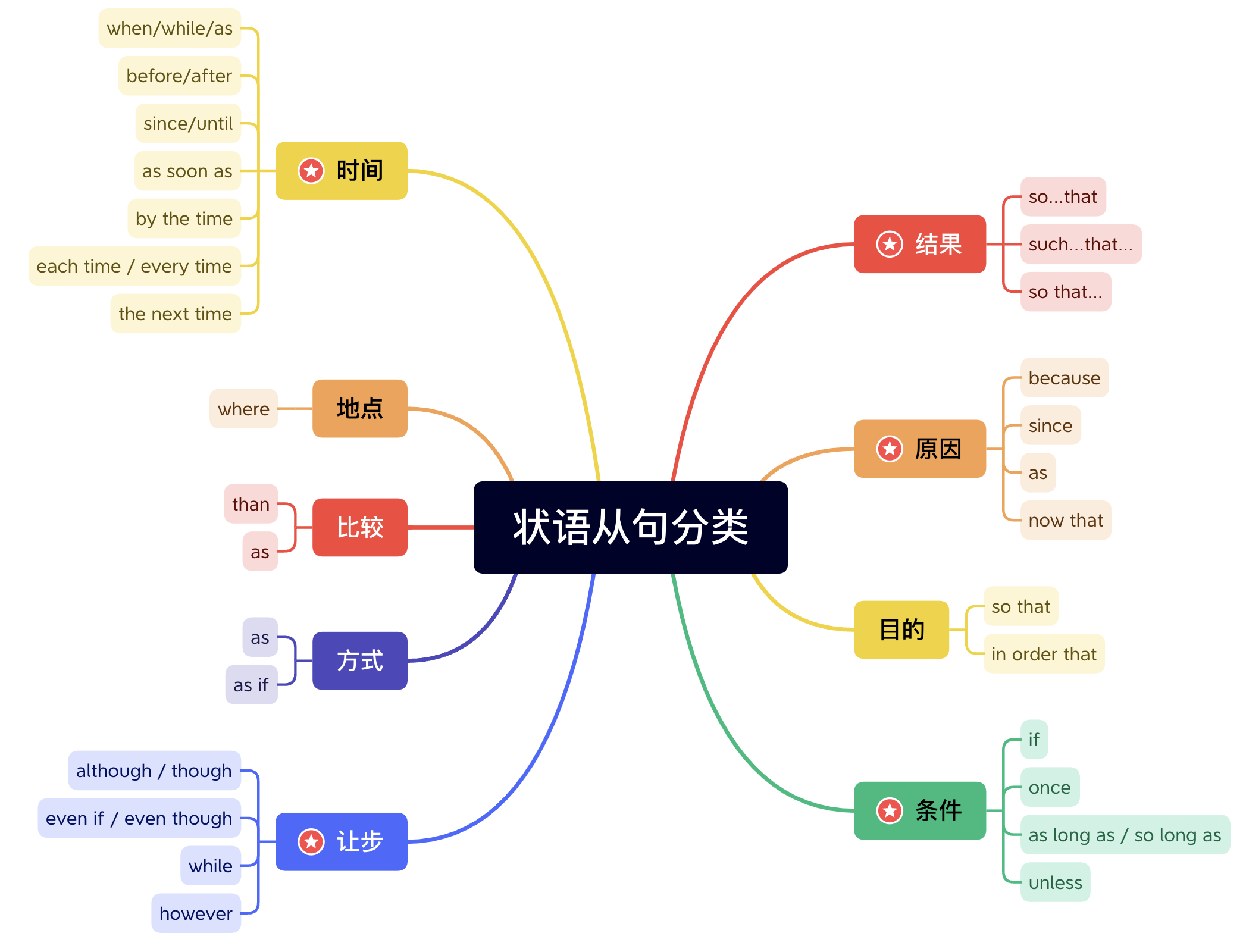
重点:时间、原因、结果、条件、让步,其他简单了解即可。
如果 as 后面从句缺成分则是定语从句,不缺则是状语从句
时间
- when / while / as(当…)
- before(…之前)/after(…之后)
- since(自…开始)/until(直到…)
- as soon as (一…就 )
- by the time(到…时候 / 截止到…)
- each time / every time(每一次)
- the next time(下一次)
地点
- where(在…的地方)
原因
- because(因为)
- since(因为)
- as(因为)
- now that - 针对于现状的原因(翻译:既然…)
结果
- so…that…(太…所以),加副词
- such… that…(太…所以),加名词或词组
- so that…(所以)
目的
so that后面有情态动词就是【目的】,没有则是【结果】
- so that…(以便…)
- in order that…(以便…)
条件
- if(如果)
- once (一旦…)
- as long as / so long as (只要…)
- unless(除非…)
让步
【明让步,暗转折】:暗含转折含义
- although / though(尽管…/即使…)
- even if / even though(即使,虽然)
- None of these will be easy but you can start even if others refuse to.
- 这些都不容易,但即使别人拒绝,你也可以开始。
- while(虽然,尽管)(放句首)
- however(无论如何)
比较
后面跟句子才是比较状语从句
- than
- as
方式
- as(按照)
- as if/though(好像)
倒装句
倒装 = 变成一般疑问句 = 把助动词放主语前
助动词 = do / does / did,be 动词,have / has / had,情态动词 will / can / must…
部分倒装
否定型 - 否定词在句首,引起倒装
否定词 = hardly, never, rarely, seldom, scarcely, no, nor, neither, none, little, few,
练习:
Seldom ____ in such a rude way.
A. we have been treated
B. we have treated
C. have we been treated
D. have we treated
点击查看答案
【answer】C
【translation】我们很少受到如此粗鲁的对待
【analysis】由于否定词 seldom 在句首,所以这是一个部分倒装,需要把【助动词】放到主语前面,故排除 A、B。C 选项为完成时态的被动,被动就是【be动词 + done】根据句意故选 C
No sooner ____ at the airport than he was informed that the flight had been cancelled.
A. he arrived
B. he had arrived
C. had he arrived
D. did he arrive
点击查看答案
【answer】C
【translation】他一到机场就被通知航班已经取消了
【analysis】no sooner…than(一…就)。看到否定词 no 在句首,就能想到这题考倒装,首先排除 A、B。他被通知是过去时,而他到达机场是比被通知还要更早的,也就是【过去的过去】,所以用过去完成时,故答案选 C
【only】型 - only 位于句首,引起倒装
Only when I sleep will I make a dream.
【as】型 - “尽管”把表语放到句首即可
- As I look ugly, I am very gentle.
- Ugly as I look, I am very gentle.
练习
____ Martin can reach the branch of that tall tree at the gate.
A. As a short man
B. Being short
C. As he is short
D. Short as he is
点击查看答案
【answer】D
【translation】尽管 Martin 很矮,却可以够得到门口的那颗大树的树枝
【analysis】as 用在句中可以起“尽管”的作用,即考察倒装。as 型倒装需要把表语前置,从句中可知 short 是表语,即选 D
【So do I】型
So do I. 我也是
So I do. 我确实是
do 表示助动词,I 表示主语
She likes English. So do I. 她喜欢英语。我也喜欢
She likes English. So she does. 她喜欢英语。她确实喜欢
So do I 的否定表达:Neither/Nor do I.
She doesn’t like English. Neither do I. 她不喜欢英语。我也不喜欢。
练习
Tom doesn’t have his own room.____.
A. Neither I do
B. Neither do I
C. Neither have I
D. Neither I have
点击查看答案
【answer】B
【translation】Tom 没有他自己的房间,我也没有。
【analysis】显然是使用 So do I 的否定形式:Neither do I,情态动词 do 可以根据前句进行判断,将【Tom doesn’t have his own room】转换为一般疑问句:【Doesn’t Tom have his own room?】由此可见助动词是doesn’t,也就是 do 的三单否定形式,而 have 为实义动词,故选 B
强调句
Trick: 看到 It is/was 开头,大概率考强调句
什么是强调句
强调说明句子里的某个部分,表达情感意愿
强调句的出现标志
It is/was + 被强调部分 + that/who + …
- 其中 who 表示人
- that 表示非人(迫不得已的时候可以表示人)
E.g.
原:We take the class in this room. 强:It is in this room that we take the class.
如何证明一个句子是强调句
把标志it is/was … that/who 去掉,仍是正确的句子就是强调句。
特殊情况
not…until
强调 not…until 结构中的时间状语,把 not 放到 until前,然后再将 not until 部分移到被强调的位置
- I didn’t go to bed until 12 p.m last night.
- It was not until 12 p.m. last night that I went to bed.
E.g.
It was his parents help ____ enabled him to buy an apartment in the big city.
A. which
B. that
C. what
D. who
It was a platform ____ people can buy and sell things on it.(不是强调句)
A. which
B. that
C. what
D. who
💛 虚拟语气
应用场景
虚拟被用来表达以下【非真实】情况 :
- 假设
- 主观愿望
- 猜测
- 建议
- 可能或空想
虚拟vs真实
真实条件句 -> 可能发生的事用主将从现
- If it rains tomorrow, I will stay at home.(如果明天下雨,我会待在家里)
虚拟条件句 -> 不可能发生的假设用虚拟语气
- If it should rain every day, I could be mad. (如果每天下雨,我可能会疯掉)
考点
不同虚拟情况下,主句、从句的谓语动词变化
Trick:看到 if 和 would、should、could、might,立刻怀疑考常规虚拟
例题:
if she ____ here, she wouldn’t have been caught in the heavy rain.
A. came
B. was coming
C. would come
D. had come
If you had told me earlier, I ____ to meet you at the hotel.
A. had come
B. will have come
C. would come
D. would have come
常规谓语动词变化规则
| 条件(从句) | 结果(主句) | |
|---|---|---|
| 现在 | 用过去时 did | 用 【would、should、could、might】+ 动词原形 |
| 过去 | 用过去完成时 had done | 用 【would、should、could、might】+ 现在完成时 |
| 将来 | 用过去时或 should do或 were to do | 用 【would、should、could、might】+ 动词原形 |
从句
在虚拟里 be 动词要变成 were
-
对现在虚拟:用过去时 did
-
对过去虚拟:用过去完成时had done
-
对将来虚拟:用过去时或 should do 或 were to do
Trick:
对什么虚拟就用它的过去时
现在 -> 现在的过去:do -> did
过去 -> 过去的过去:did -> had done
将来 -> 将来的过去:shall do -> should do. be to do -> were to do
主句
- 对现在/将来虚拟:用 【would、should、could、might】+ 动词原形
- 对过去虚拟,用 【would、should、could、might】+ 现在完成时
特殊情况
should + do 可省略
should 可以省略,do 是动词原形
- 以防
- in case (that) 万一,如果
- for fear (that) 以防万一
- lest 以免,避免
- 命令
- order 命令
- direct 指导
- command 命令
- instruct 指示
- 建议
- advise 劝告、建议
- suggest 建议
- propose 提议
- recommend 建议、推荐
- motion 提议
- 坚持/要求/主张
- insist 坚持
- require 需要,规定
- request 要求,请求
- demand 强烈要求,需要
- ask 要求
- resoltion 决定
- plan 计划
- 必要
- It is [necessary][urgent][important][essential] that …
以上表达换了词性用法依旧
Example
- We took a lot of guns with in case/for fear that/lest it (should) meet teerorist.
- 为了防备恐怖分子,我们带了很多枪
- I suggest that you (should) be kind.
- 我建议你善良
should + do 不可省略
从句的谓语动词要用“should + do”,意为“竟然,居然”。should 不可省略!
- “It is/was [a pity(可惜)][a shame(耻辱)][no wonder(难怪)][amazing(惊人的)][surprising(惊喜的)][astonishing(惊人的)][shocking(震惊的)][strange(奇怪的)] + that从句”
- “I am/was 【sorry/surprised/disappointed】… + that从句”
E.g.
- It is astonishing that he should be so rude to you.
- 他竟然对你如此粗鲁,真令人吃惊。
- It is a pity that Henry should make such a mistake.
- 亨利居然犯了这样的错误,真可惜
- I am very disappointed that he should do such a thing.
- 他竟然做这样的事,我很失望
省略 if,引起倒装
省略 if,要把 were、had、should 等放在主语前,部分倒装
倒装 = 变成一般疑问句 = 把助动词放到主语前
助动词 = be 动词,do/does/did, have/has/had, 情态动词
E.g.
原:If she had come here, she wouldn’t have been caught in the heavy.
省:Had she come here, she wouldn’t have been caught in the heavy.
It is (high/about) time + that从句
意思为:该是…的时候了
在“It is (high/about) time + that 从句”句型中,从句谓语动词多用过去式,也可以用“should + do”,并且 should 不可省略
E.g.
- It is high time that you studied the problem carefully about what you will do in the future.
- It is high time that you should study the problem carefully about what you will do in the future.
- 现在是你仔细研究这个问题的时候了,你将来要做什么。
- It is (high) time (that) you learnt/learned/should learn to cook.
- 该是你学习烹饪的时候了
用从句的虚拟规则
以下列出的谓语动词变换为特殊情况,其余未列出的使用常规虚拟的从句谓语动词规则即可
- would rather(宁愿)/would sooner(宁愿)/would prefer(宁愿)/would (just) as soon(将会尽快)
- 表示 将来或现在 时用过去时
- wish/if only(要是…就好了)/as if(好像)/as though(好像)
- 表示 将来 用 “would/could/might + do
E.g.
I would rather I hadn’t opened the door for you last week.
I wish I knew what is happening there in his room.
用主句的虚拟规则
【without(如果没有), but for(要不是),but (that)(要不是), otherwise(否则), under(按照)】,用主句的虚拟规则
E.g.
I passed the test. I ____ it without your help. (对过去虚拟)
A. would not pass
B. wouldn’t have passed
C. didn’t pass
D. had not passed
插入语
什么是插入语
- 插入语就是前后用逗号隔开,插在主句里面。
- 删掉插入语不会影响整体句子的意思
- 可以插入一个词、一个短语、几个词、一个句子
例:
I think there are other measures which could be equally, if not more, effective.
我认为其他的措施可能同样有效,甚至更多。
为什么要用插入语
进行补充说明,让句子更加的精确客观,对句子进行强调,进行过度转折
- Cats, it seems, love to chew up cable.
- 似乎猫喜欢咬电线
- The reason, of course, is that costs have rocketed.
- 原因当然是成本飞涨
- Instead of becoming a doctor, however, he bacame a successful writer of deective stories.
- 然而,他没有成为一名医生,而是成为了一名成功的侦探小说作家。
插入语插哪
句首、句中、句尾 都行
-
Strange, there is nobody in the classroom.
-
奇怪,教室里没人
-
Thrkey would, of course, be the main dish.
-
当然,火鸡将是主菜
-
I prefer to go tomorrow afternoon, at 6 pm.
-
我打算明天下午去,在下午 6 点吧
参考资料
- https://www.bilibili.com/video/BV1Z4411C7jG
- https://www.bilibili.com/video/BV1XY411J7aG
- https://wordvice.cn/topic/category/language-rules
核心语法(刘晓燕考研英语)
简单句
什么是英语句子
必须具备主谓结构,主语一定是谓语动作的发出者,如果有宾语的话,宾语一定是谓语动作的承受者
句子的基本结构
1. 主谓
2. 主谓宾
谓语:实义动词(有实际意义的动词)
3. 主系表
谓语:系动词:
- be
- 感官动词:look(=seem=appear)、smell(n. 气味)、taste(n. 喜爱 爱好)、sound、feel
- 变化:become, get,turn, grow, fall
- 保持:keep,stay,remain,stand
- 表象:seem, appear
- 终止:prove
4. 主谓双宾
5. 主谓宾宾补
只需要在两个宾语之间加个 be 动词,如果读起来意思是对的,就是主谓宾宾补,如果读起来意思不对就是双宾
句子的成分(词性的问题)
谓语
1. 谓语的成分
有时态的实义动词或系动词充当谓语
2. 一句话当中动词能不能多?
-
不能多
-
一句话当中只能有一个动词,并且充当谓语,多余的动词全部都要变成非谓语动词。
-
❌ Laugh at others is my hobby.
-
✅ Laughing at others is my hobby.
-
❌ I enjoy see movies.
-
✅ I enjoy seeing movies.
-
❌ My dream is become a rich lady.
-
✅ My dream is to become a rich lady.
谓语只能是动词,动词只能做谓语。 要把一句话当中不是谓语的动词变成不是动词(非谓语动词):
- V + ing 表示主动
- V + ed 表示被动
- to + do 表示目的
3. 一句话当中动词能不能少
- 不能少,当一句话需要动词而没有动词的时候,永远都加 be 动词,并且 be 动词没有意思。
- ❌ Your mother must very beautiful.
- ✅ Your mother must be very beautiful.
- ❌ I against you.
- ✅ I am against you.
4. 谓语的总结
一句话当中,有且只能有一个有时态的实义动词或系动词的存在,并且充当谓语。
谓语练习
- 他穿上外衣,锁上门,离开了家。
- He putting on his jacket, locking the door, left home.
- 大熊猫是熊科中最罕见的成员, 常居在中国西南部的森林里。
- Pandas are the rarest members in bear family, mainly living in the fonest of Chinese South west
- 长江流经不同的生态体系,是诸多濒危物种的栖息地,灌溉了中国五分之一的土地。
- YangZi River flowing through diverse ecological systems, keeps the home of a sea of endangered species, irrigoating Chinese 1/5 land.
- 我爱你,你爱我
- I loveing you, you love me.(独立主格)
- 冬天来了,春天就不远了
- Winter approaching, spring will be around the corner.
- 我是一个老师,我很喜欢唱歌。
- Being a teacher, I have passion for singing songs.
主语
1. 主语的成分
-
名词
-
代词
-
非谓语动词
-
从句(引导词+句子)
-
❌ Handsome and strong are his nature.
-
✅ Being Handsome and strong is his natrue.
2. 一句话当中主语能不能少?
不能 一句话没有主语的时候怎么办?
- 加 it 作为主语:必须与天气、温度、时间有关系
- there be句型,听到“有”的时候使用。
- There exist a host of undergraduates being fascinated with me.
- !!!被动:当听到一句话没有主语,或者人称代词做主语的时候,都可以考虑写成被动
- 必须指出坚持很重要 => Persistence must be pointed out outstandingly crucial.
- 越来越多的人认为过度捕捞很严重 => Overfishing is claimed more than fearful by an increasing amount of professors.
三种情况无被动:
- 动词后面有介词的话,该动词无被动
- go to school
- 系动词没有被动
- have 翻译成“有”的时候,没有被动
- 人称代词做主语:不到万不得已,最好不要使用
3. 练习
- 如果有梦想,就应该会成功
- If there exists a dream, glories are supposed to be achieved.
宾语(动词的承受者)
主语和宾语的成分一样:
- 名词
- 代词
- 非谓语动词
- I love to sing songs.
- 从句
- I love you.
表语
- 名词
- I am a teacher.
- 代词
- Who’s your best friend?
- 非谓语动词
- My dream is to become a poet.
- My dream is becoming a poet.
- 从句
- 形容词
- I am beautiful.
- 介词短语
- I am in Chongqing.
简单句的考点分析
写作
- 所有写不来的长难句,暂时都先写成简单句,一定要保证语法正确。
- 所有不会写的单词,都可以写成自己会的词汇
长难句分析
- 找谓语动词,找主谓宾
- 有多个动词时找主句的动词,前面没有引导词的动词就是主句的动词
并列句
并列句就是用连词连接的两个句子
并列连词
- 平行:and, not only … but aloso …
- 转折:but, yet, while, whereas
- 选择:or, whether … or …
- 因果:for, so
- 递进:then
逻辑关系词
- 平行
- similarly
- equally
- likewise
- at the same time / in the mean while
- 转折
- however
- nevertheless
- on the contrary / by contrast
- conversely
- unexpectedly
- unfortunately
- 选择
- alternatively
- 因果
- therefor
- thus consequently
- as a result
- 递进
- besides
- furthermore
- moreover
- additionally
- subsequently
- in addition
连词与副词、介词短语的区别
- 使用连词时,可以加逗号,也可以不加
- 其他逻辑关系词的前面,要么用句号,要么加连词 and
考点分析
写作
只要写作的上下句之间有关系,就一定要用逻辑关系词(连词、副词、介词和介词短语) 练习写句子:
-
有朋自远方来,不亦乐乎
-
There remain an army of companies coming from afar, and consequently, I feel more than delighted.
-
都说我如水百变,可知我清澈不变
-
I am claimed changeable like water.By contrast, my clarity keeps consistent.
-
还记得那天吗?我没有通过四级考试,一个人在雨中哭泣,你走过来,拍拍我的肩膀,告诉我人生没有终点
-
Do you stiill keep that day in mind? I failed to pass CET4, and as a result, I shed tears in the rain alone. At the same time, you came up to me and subsequently you beat my shoulder and told me “thare exists no destination in life”.
完形填空
只需要读懂逻辑关系词前后两句话的意思即可
长难句分析
在分析长难句的时候,只要有并列连词的出现,通常都会有省略 分析长难句的第二步就是找连词,但是在连词连接两个单词的时候,这个连词就装作没看见,无论何时
- 如何查找省略的内容?
- 一句话只要有省略,就一定会省略在连词后 -> 所以连词后面有的成分,连词前面一定有 -> 连词前面有而后面没有的成分就是省略的部分
名词性从句
名词能做什么成分
- The movies looks terrific(充当主语)
- I admine his mother (充当宾语)
- Gump is a man(充当表语)
- I enjoy the part, the beginning.(充当同位语)
同位语:用来解释名词的成分
- 只要在作文中见到名词,都可以有意识的在后面加个同位语,对该名词进行补充说明。
- Persistence, an active mentality, plays a critical role in the glories of all children and adults.
- My mother, a typical housewife, enjoy playing Mahjong, a chinese enthertainment.
同位语的成分(什么可以用来解释名词):
- 名词
- 代词
- 非谓语动词
- 从句
什么是名词性从句
名词在句子中能够充当的成分,从句都能充当,这就是名词性从句
- What I saw is attractive.
- I appreciate what she said.
- Gump is who should learn from.
- I enjoy the part that a feather is flying in the sky.
名词性从句的引导词
- That he has got divorced is my fault.
- Whether has he got divorced is obvious.
- Who will he marry is a secert.
名词性从句的引导词是按照从句的类型分的类,一共把引导词分为 3 类:
- That: 当从句是陈述句时。并且 That 在从句中不充当任何成分,也没有任何意思。
- Whether: 当从句是一般疑问句时。并且 Whether 在从句中也不充当成分,意思是“是否”。
- 所有的特殊疑问词:当从句是特殊疑问句时。
- 英语中所有的从句,都是陈述句的形式。
练习句子:
-
我正在思考外星人存在吗
-
I am wondering whether aliens exist.(宾语从句)
-
女人总是对的,是一个常识。
-
That ladies tend to be right remains common knowledge.
-
It remain common knowledge that ladies tend to be right.
-
我的意思是,孝敬父母是中华民资的传统美德。
-
My meaning seems that supporting the elderly remains a chinese conventional virtue.(表语从句)
-
有一天你会发现,事业、亲情、友情,都比爱情重要。
-
Someday, one will perceive that career, kinship and friendship prove more indispensovble than romance.(That 引导的宾语从句)
-
The point seems when wealth will become available for you.
考点分析
写作
主语从句
把主语从句放在句末,用 it 作形式主语。
- It… that…
- It is apparent that…
- It looks beyond dispute that…
- It has been widely accepted that…
- It is universally acknowledged that…
- It keeps my argument that…
主语从句的满分句型,可以写在作文中任何一句话前面 练习:
- 显而易见,关于勤奋这个话题已经引起关注了
- It is looks beyond dispute that the issue about diligence has been brought into the limelight
同位语从句
The matter that he managed to find a girlfriend makes his superiours rejoiced. 同位语从句既可以放在它所解释的名词后,也可以放在整句话的后面。
-
没有什么能够掩盖他正在变老这个事实
-
Nothing can hide the truth that she is getting old.
-
河南人都是骗子这种想法是不正确的
-
The outlook proves wrong that private individuals in HeNan seem all deceivers
-
温室里的花朵,不能经受风雨,这个事实表明我们不该溺爱孩子
-
The evidence flowers in the greenhouse fail to undergo storms indicates that kids should by no means spoiled by thein.
长难句分析
能够识别各个名词性从句,并把他们通顺地翻译出来
如何识别主语从句
- 只要见到有引导词放在句首,并且从句后没有被逗号隔开,就一定是主语从句。
- 主语从句从 that 开始到谓语动词(组)结束。
- It… that 通常都是主语从句。
练习句子
-
板块正在移动是毋容置疑的。
-
That the plates are moving is now beyond dispute.
-
Whether the Government should increase the financing of pure science at the expense of technology or vice versa often depends on the issue of which is seen as the driving force.
-
政府应该以牺牲技术增加对纯科学的投入,还是以牺牲纯科学为代价增加对技术的投入,这取决于哪一个问题被视为驱动力
-
How well the predictions will be validated by later performance depends upon the amount, reliability, and appropriateness of the information used and on the skill and wisdom with which it is interpreted.